
LDM163-182 Pre-installed Applications: Difference between revisions
Created page with "<noinclude> <div class="noprint"> <div style="top:1px;width:auto;" class="nomobile"> <div class="grid-container"> <div class="item1" style="text-align:center; font-size:16; background-color:#DB0025; font-weight:bold; color:#ffffff;">{{PAGENAME}}</div> <div class="grid-item">Introduction </div> <div class="grid-item">Remote Control </div> <div class="grid-item">LDM163-182_Wall_Installation|Wall Installati..." |
No edit summary |
||
| Line 23: | Line 23: | ||
</div> | </div> | ||
{{Top}} </noinclude> | {{Top}} </noinclude> | ||
=vCast= | |||
Working with ViewSonic® Cast software (vCast, vCast Pro, and vCastSender), the vCast application will allow the display to receive laptop screens (Windows/Mac/Chrome) and mobile (iOS/Android) users’ screens, photos, videos, annotations, and camera(s) that are using the vCastSender application. | |||
<div class="res-img">[[File:IFP52_vCast_Sender_1.png|ViewBoard Cast (vCast)|500px]]</div> | |||
==Network Information== | |||
*ViewSonic® Cast software, laptops, and mobile devices can connect to both the same subnet and cross subnet by entering the on-screen PIN code. | |||
*Connected devices will show up under '''Device List''' on the same subnet connection. | |||
*If the device does not show up under '''Device List''', users will need to key-in the on-screen PIN code. | |||
*'''Ports:''' | |||
::<i class="fas fa-chevron-right fa-xs"></i> TCP 56789, 25123, 8121 & 8000 (Controlling message port & client device audio transfer) | |||
::<i class="fas fa-chevron-right fa-xs"></i> TCP 8600 (BYOM) | |||
::<i class="fas fa-chevron-right fa-xs"></i> TCP 53000 (Request share screen) | |||
::<i class="fas fa-chevron-right fa-xs"></i> TCP 52020 (Reverse control) | |||
::<i class="fas fa-chevron-right fa-xs"></i> TCP 52025 (Reverse control for the ViewBoard Cast Button only) | |||
::<i class="fas fa-chevron-right fa-xs"></i> TCP 52030 (Status sync) | |||
::<i class="fas fa-chevron-right fa-xs"></i> UDP 48689, 25123 (Device searching and broadcast & client device audio transfer) | |||
::<i class="fas fa-chevron-right fa-xs"></i> UDP 5353 (Multicast search device protocol) | |||
*'''Port and DNS Activation:''' | |||
::<i class="fas fa-chevron-right fa-xs"></i> Port: 443 | |||
::<i class="fas fa-chevron-right fa-xs"></i> DNS: <nowiki>https://vcastactivate.viewsonic.com</nowiki> | |||
*'''OTA Service:''' | |||
::<i class="fas fa-chevron-right fa-xs"></i> Server Port: TCP443 | |||
::<i class="fas fa-chevron-right fa-xs"></i> Server FQDN Name: <nowiki>https://vcastupdate.viewsonic.com</nowiki> | |||
==Display Group Settings== | |||
To adjust the Display Group Settings, select the Display Group icon [[File:Icon_Display_Group.png|Display Group icon|30px]] located in the lower-right corner of the screen. | |||
<p>[[File:LDS135-153_vCast_Display_Group.png|500px]] | |||
</p> | |||
<ol> | |||
<li>Toggle the “Turn On/Off Display Group” ON to enable the Display Group feature.<br> | |||
<p>[[File:LDS135-153_vCast_Display_Group_Switch_Button.png|350px]] | |||
</p> | |||
{{Note|Other preinstalled-vCast devices in the same network will be listed.}} | |||
</li> | |||
<li>Select the devices you want to join the display group and select '''OK''' to save the settings.<br> | |||
<p>[[File:LDS135-153_vCast_Display_Group_Select.png|300px]] | |||
</p> | |||
{{Note| | |||
:*If the devices you want to group are not listed, you can enter their respective IP address or connecting PIN code. | |||
:*The Display Group maximum device limit is six devices. | |||
}} | |||
</li> | |||
<li>If you frequently connect to the same device, you can select the Star icon <i class="fa fa-star" aria-hidden="true" style="font-size:24px; color:orange"></i> next to the device to add it to your frequently connected devices list, “My List of Devices in Group”, for easier Display Group setup and management.<br> | |||
<p>[[File:LDS135-153_vCast_Display_Group_Favorite.png|300px]] | |||
</p> | |||
</li> | |||
</ol> | |||
==Synchronized Group Screen All the Time== | |||
<div> | |||
<p>When the “Synchronized group screen all the time” function is toggled ON, it will display a synchronized group screen continuously. If it is toggled OFF, it will work on vCast mirroring only. | |||
</p> | |||
<p>[[File:LDS135-153_vCast_Display_Group_Switch_Button.png|350px]] | |||
</p> | |||
{{Note|Select the devices to group first, then toggle the “Synchronized group screen all the time” function ON to avoid interruption.}} | |||
==Share a Screen to the Display Group (One to Many Casting)== | |||
After confirming the above settings, you can share your screen to the main display, then the grouped client devices will be synced up to your screen. | |||
<div class="res-img">[[File:vCast_Pro_Display_Group_6.png|500px|vCast Pro Display Group]]</div> | |||
==Moderator Mode== | |||
Moderator Mode allows the moderator to take control of the devices connected to the display. To enter Moderator Mode, select the Moderator Mode icon [[File:vCast_Pro_MM_Icon.svg|20px|link=]] located in the lower-right corner of the screen. | |||
<div class="res-img">[[File:vCast_Pro_Moderator_Mode_1.png|500px|vCast Pro Moderator Mode]]</div> | |||
When enabled, the moderator can view a list of all connected screens in the left floating window and can preview each participant’s screen and then select any of participant’s screen and cast to the display's main screen for presentation. The moderator can also control each participant’s screen, annotate on the display, and remove unwanted participants by selecting the close icon <i class="fa fa-close" style="font-size:24px;"></i>. | |||
<div class="res-img">[[File:vCast_Pro_Moderator_Mode_2.png|500px|vCast Pro Moderator Mode]]</div> | |||
==Broadcast== | |||
When enabled, the display's screen will be broadcasted to all of the participant’s connected screens simultaneously. The participants can only view the presentation contents until the moderator disables the Broadcast function. | |||
<div class="res-img">[[File:vCast_Pro_Broadcast.png|500px|vCast Pro Broadcast]]</div> | |||
==Multiple Screen Sharing== | |||
By default, vCast is set to allow multiple screen sharing, but can also be set to single screen sharing. To do this, the moderator can select the Multiple Screen Sharing icon to switch to single screen sharing. | |||
==Preview Screen== | |||
By default, vCast is set to let the moderator preview the participant’s screen contents prior to sharing to the display. Selecting the Preview Screen icon, the Moderator can switch to see the participant’s name only. | |||
==Touch== | |||
By default, participants can use touch for collaboration after connecting. The moderator can enable/disable the touch function of a participant by selecting the Touch icon in their window. | |||
{{Note| | |||
:*Moderator Mode is supported on all vCastSender and AirPlay devices, but mobile devices are limited to a "preview" function. Additionally, mobile Android devices cannot cast sound out. | |||
:*When you cast your Windows/Mac/Chrome screen to a display, the selected full screen unit will not be broadcasted back to your device to avoid repetitive screen casting. | |||
:*The active presenter can touch each of the participant's screens to remotely control casting devices. | |||
:*The number of multi-screen presenters on-screen depends on your Windows CPU processor performance and router specifications. | |||
}} | |||
==Casting from Windows, MacBook, and Chrome Devices== | |||
<div class="res-img">[[File:IFP52_vCast_Sender_1-1.png|500px]]</div> | |||
<ol><li>Ensure the client device (e.g., laptop) is connected to the same network as the display.</li> | |||
{{Note|The network name can be found under '''Room Network'''.[[File:vCast_Computer_1.png|center|400px]] | |||
}} | |||
<li>On the client device, visit the address that is shown on the display to download and install the vCastSender application.</li> | |||
<li>After installing, launch the vCastSender application.</li> | |||
<li>To connect to the display, input the PIN code and click '''OK'''.</li> | |||
{{Note|The '''PIN code''' can be found as highlighted below:[[File:vCast_Computer_2.png|center|400px]] | |||
}} | |||
<li>Additionally, you can connect to the display by clicking '''Device List''' then the '''Device Name''' listed.</li> | |||
<div class="res-img">[[File:vCast_Computer_3.png|400px]]</div> | |||
{{Note|The '''Device Name''' can be found as highlighted below:[[File:vCast_Computer_4.png|center|400px]] | |||
}} | |||
</ol> | |||
==Casting from Android Devices== | |||
<div class="res-img">[[File:vCast_Mobile_Update_1.png|500px]]</div> | |||
<ol><li>Ensure the client device (e.g., Android phone or tablet) is connected to the same network as the display.</li> | |||
{{Note|The network name can be found under '''Room Network'''.[[File:vCast_Computer_1.png|center|400px]] | |||
}} | |||
<li>On the Android client device, scan the QR code shown on the display to directly download the vCastSender application, or download the application from the [https://play.google.com/store/apps/details?id=com.viewsonic.vcastsender&pcampaignid=web_share|the Google Play Store].</li> | |||
:<div class="res-img">[[File:vCast_Sender_3.png|400px]]</div> | |||
<li>After installing, launch the vCastSender application.</li> | |||
<li>To connect to the display, input the '''PIN code''' and select '''OK'''.</li> | |||
{{Note|The '''PIN code''' can be found as highlighted below:[[File:vCast_Computer_2.png|center|400px]] | |||
}} | |||
<li>You can also connect to the display by clicking '''Device List''' then the '''Device Name''' listed.</li> | |||
<div class="res-img">[[File:vCast_Sender_Device_List_Scan.png|300px]]</div> | |||
{{Note|The '''Device Name''' can be found as highlighted below:[[File:vCast_Computer_4.png|center|400px]] | |||
}} | |||
<li>Additionally, you can connect to the display by selecting '''Scan''' then placing the on-screen QR code into the box to automatically connect.</li> | |||
<div class="res-img">[[File:vCast_Computer_5.png|600px]]</div> | |||
</ol> | |||
==Casting from Apple iOS Devices== | |||
Apple AirPlay® is compatible with vCast for screen mirroring and content streaming under the same subnet environment only. An “AirPlay Password” will be generated on-screen for connection when using AirPlay to cast to a display. | |||
<div class="res-img">[[File:vCast_Apple_Main.png|500px]]</div> | |||
<ol><li>Ensure the client device (e.g., iPhone or iPad) is connected to the same network as the display.</li> | |||
{{Note|The network name can be found under '''Room Network'''.[[File:vCast_Computer_1.png|center|400px]] | |||
}} | |||
<li>On the iOS client device, directly open AirPlay and select the '''Device Name''' of the display to connect.</li> | |||
{{Note|The '''Device Name''' can be found as highlighted below:[[File:vCast_Computer_4.png|center|400px]]}} | |||
<li>Input the generated on-screen '''AirPlay Password''' on the client device to connect.</li> | |||
<div class="res-img">[[File:vCast_Sender_4.png|400px]]</div> | |||
{{Note|In a cross subnet environment, please download and connect with the vCastSender iOS application from the the Apple App Store.}} | |||
<li>You can also connect to the display by selecting '''Scan''' then placing the on-screen QR code into the box to automatically connect.</li> | |||
:<div class="res-img">[[File:vCast_Computer_5.png|600px]]</div> | |||
</ol> | |||
=Connecting to a Display from Mobile Device= | |||
Once connected, select '''Receive'''. The selected display screen will appear on the mobile device with an on-screen toolbar. Users can interact with the display with annotations, file sharing, etc. | |||
<div class="res-img">[[File:vCast_Pro_Additional_2.png|600px|Additional Features]]</div> | |||
{| class="wikitable" style="text-align:center; background-color:#ffffff; width:60%;" | |||
|- | |||
! colspan="2" style="border-color:inherit; font-weight:bold; background-color:#db0025; color:#ffffff;" | Item | |||
! style="font-weight:bold; background-color:#db0025; color:#ffffff;"|Description | |||
|- | |||
| style="border-color:inherit;" | <div class="res-img">[[File:vCast_Pro_Toggle.svg|30px]]</div> | |||
| style="font-weight:bold;" | Toggle | |||
| style="text-align:left;" | Hide or display the toolbar. | |||
|- | |||
| style="border-color:inherit;" | <div class="res-img">[[File:vCast_Pro_Home.svg|30px]]</div> | |||
| style="font-weight:bold;" | Home | |||
| style="text-align:left;" | Return to the Home interface. | |||
|- | |||
| style="border-color:inherit;" | <div class="res-img">[[File:vCast_Pro_Return.svg|30px]]</div> | |||
| style="font-weight:bold;" | Return | |||
| style="text-align:left;" | Return to the previous operation. | |||
|- | |||
| style="border-color:inherit;" | <div class="res-img">[[File:vCast_Pro_Folder.svg|30px]]</div> | |||
| style="font-weight:bold;" | Folder | |||
| style="text-align:left;" | View or open the mobile device's files. | |||
|- | |||
| style="border-color:inherit;" | <div class="res-img">[[File:vCast_Pro_Share.svg|30px]]</div> | |||
| style="font-weight:bold;" | Share | |||
| style="text-align:left;" | Cast the mobile device's screen to the connected display. | |||
|- | |||
| style="border-color:inherit;" | <div class="res-img">[[File:vCast_Pro_Touch.svg|30px]]</div> | |||
| style="font-weight:bold;" | Touch | |||
| style="text-align:left;" | Remotely control the connected display. | |||
|- | |||
| style="border-color:inherit;" | <div class="res-img">[[File:vCast_Pro_Annotate.svg|30px]]</div> | |||
| style="font-weight:bold;" | Annotate | |||
| style="text-align:left;" | Make annotations, and adjust the pen color. | |||
|- | |||
| style="border-color:inherit;" | <div class="res-img">[[File:vCast_Pro_Clear.svg|30px]]</div> | |||
| style="font-weight:bold;" | Clear | |||
| style="text-align:left;" | Clear everything on screen. | |||
|- | |||
| style="border-color:inherit;" | <div class="res-img">[[File:vCast_Pro_Camera.svg|30px]]</div> | |||
| style="font-weight:bold;" | Camera | |||
| style="text-align:left;" | Send camera images to the connected display. | |||
|} | |||
=Casting with Chromecast= | |||
<div> | |||
vCast supports native Chromecast screen sharing via the Chrome browser casting when the Chromecast feature is enabled. | |||
{{Note|Chromecast does not support password protection or multiple-screen casting.}} | |||
<ol> | |||
<li>Ensure the client device (e.g., laptop) is connected to the same network as the display. | |||
{{Note|The network name can be found under '''Room Network'''.[[File:vCast_Computer_1.png|center|400px]]}} | |||
</li> | |||
<li>Ensure the '''Chromecast Enable''' checkbox is selected in the vCast settings.<br> | |||
<p>[[File:VCast_Chromecast_Enable.png|500px|VCast Chromecast Enable]] | |||
</p></li> | |||
<li>In the Chrome browser, go to: '''Settings > Save and share > Cast...''' > Select the screen to cast to.<br> | |||
<p>[[File:VCast Chromecast Enable Select Screen.png|500px|VCast Chromecast Select Screen]] | |||
</p></li> | |||
</ol> | |||
</div> | |||
=Casting with Miracast= | |||
<div> | |||
vCast supports native Miracast to cast content from Windows and Android devices to a display when the Miracast feature is enabled. | |||
{{Note| | |||
:*Miracast does not support password protection or multiple-screen casting. | |||
:*Miracast sharing is only available over Wi-Fi. | |||
:*Miracast will automatically turn off after being idle for one hour. | |||
}} | |||
<ol> | |||
<li>Ensure the client device (e.g., laptop) is connected to the same network as the display. | |||
{{Note|The network name can be found under '''Room Network'''.[[File:vCast_Computer_1.png|center|400px]]}} | |||
</li> | |||
<li>Ensure the '''Miracast Enable''' checkbox is selected in the vCast settings.<br> | |||
<p>[[File:VCast_Miracast_Enable.png|500px|VCast Miracast Enable]] | |||
</p></li> | |||
<li>Please follow the below steps to cast:<br> | |||
<p><u>For Windows devices:</u> | |||
<ol> | |||
<li>On the Windows device, press Win + K and select the display to cast to.<br> | |||
<p>[[File:VCast_Miracast_Window-1.png|300px|VCast Miracast Window Operation 1]] | |||
</p></li> | |||
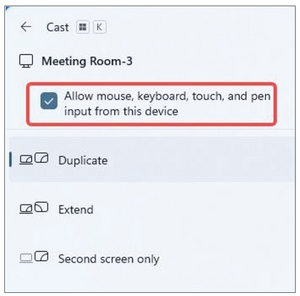
<li>Select the checkbox “Allow mouse, keyboard, touch, and pen input from the device” to enable the touch feedback feature.<br> | |||
<p>[[File:VCast_Miracast_Window-2.png|300px|VCast Miracast Window Operation 2]] | |||
</p></li> | |||
</ol> | |||
</p> | |||
<p><u>For Android devices:</u><br> | |||
On the Android device, directly select Cast/Smart View/Wireless Projection then select the display to cast to. | |||
</p> | |||
</li> | |||
</ol> | |||
=Other Default Applications= | |||
==Browser== | |||
Web browser for surfing the internet. | |||
<div class="res-img">[[File:Browser.png|500px]]</div> | |||
==Office Suite== | |||
Create, edit, and view Documents, Spreadsheets, Presentations, and PDFs. | |||
<gallery mode="nolines" heights="400px" widths="400px"> | |||
File:OfficeSuite_1.png | |||
File:OfficeSuite_2.png | |||
</gallery> | |||
==vSweeper== | |||
Clear unnecessary data and unwanted files. | |||
<div class="res-img">[[File:vSweeper_1.png|500px]]</div> | |||
Advanced Settings can also be customized to the user's needs. | |||
<div class="res-img">[[File:vSweeper_2.png|500px]]</div> | |||
{{#seo: | |||
|title=ViewSonic Direct View LED Display | |||
|title_mode=append | |||
|keywords=LDM231-251, Direct View LED, Embedded Applications, AirPlay, vSweeper, vCast, ViewBoard Cast, WPS office, browser | |||
|description=Find out more information about the embedded applications of LDM231-251. | |||
}} | |||
[[Category:LDM231-251]] | |||
Revision as of 09:50, 27 August 2024
vCast
Working with ViewSonic® Cast software (vCast, vCast Pro, and vCastSender), the vCast application will allow the display to receive laptop screens (Windows/Mac/Chrome) and mobile (iOS/Android) users’ screens, photos, videos, annotations, and camera(s) that are using the vCastSender application.

Network Information
- ViewSonic® Cast software, laptops, and mobile devices can connect to both the same subnet and cross subnet by entering the on-screen PIN code.
- Connected devices will show up under Device List on the same subnet connection.
- If the device does not show up under Device List, users will need to key-in the on-screen PIN code.
- Ports:
- TCP 56789, 25123, 8121 & 8000 (Controlling message port & client device audio transfer)
- TCP 8600 (BYOM)
- TCP 53000 (Request share screen)
- TCP 52020 (Reverse control)
- TCP 52025 (Reverse control for the ViewBoard Cast Button only)
- TCP 52030 (Status sync)
- UDP 48689, 25123 (Device searching and broadcast & client device audio transfer)
- UDP 5353 (Multicast search device protocol)
- Port and DNS Activation:
- Port: 443
- DNS: https://vcastactivate.viewsonic.com
- OTA Service:
- Server Port: TCP443
- Server FQDN Name: https://vcastupdate.viewsonic.com
Display Group Settings
To adjust the Display Group Settings, select the Display Group icon  located in the lower-right corner of the screen.

- Toggle the “Turn On/Off Display Group” ON to enable the Display Group feature.
 Note: Other preinstalled-vCast devices in the same network will be listed.
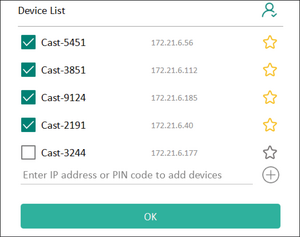
 - Select the devices you want to join the display group and select OK to save the settings.
 Note:
Note:- If the devices you want to group are not listed, you can enter their respective IP address or connecting PIN code.
- The Display Group maximum device limit is six devices.
- If you frequently connect to the same device, you can select the Star icon next to the device to add it to your frequently connected devices list, “My List of Devices in Group”, for easier Display Group setup and management.


Synchronized Group Screen All the Time
When the “Synchronized group screen all the time” function is toggled ON, it will display a synchronized group screen continuously. If it is toggled OFF, it will work on vCast mirroring only.

After confirming the above settings, you can share your screen to the main display, then the grouped client devices will be synced up to your screen.

Moderator Mode
Moderator Mode allows the moderator to take control of the devices connected to the display. To enter Moderator Mode, select the Moderator Mode icon  located in the lower-right corner of the screen.

When enabled, the moderator can view a list of all connected screens in the left floating window and can preview each participant’s screen and then select any of participant’s screen and cast to the display's main screen for presentation. The moderator can also control each participant’s screen, annotate on the display, and remove unwanted participants by selecting the close icon .

Broadcast
When enabled, the display's screen will be broadcasted to all of the participant’s connected screens simultaneously. The participants can only view the presentation contents until the moderator disables the Broadcast function.

Multiple Screen Sharing
By default, vCast is set to allow multiple screen sharing, but can also be set to single screen sharing. To do this, the moderator can select the Multiple Screen Sharing icon to switch to single screen sharing.
Preview Screen
By default, vCast is set to let the moderator preview the participant’s screen contents prior to sharing to the display. Selecting the Preview Screen icon, the Moderator can switch to see the participant’s name only.
Touch
By default, participants can use touch for collaboration after connecting. The moderator can enable/disable the touch function of a participant by selecting the Touch icon in their window.
- Moderator Mode is supported on all vCastSender and AirPlay devices, but mobile devices are limited to a "preview" function. Additionally, mobile Android devices cannot cast sound out.
- When you cast your Windows/Mac/Chrome screen to a display, the selected full screen unit will not be broadcasted back to your device to avoid repetitive screen casting.
- The active presenter can touch each of the participant's screens to remotely control casting devices.
- The number of multi-screen presenters on-screen depends on your Windows CPU processor performance and router specifications.
Casting from Windows, MacBook, and Chrome Devices

- Ensure the client device (e.g., laptop) is connected to the same network as the display.
- On the client device, visit the address that is shown on the display to download and install the vCastSender application.
- After installing, launch the vCastSender application.
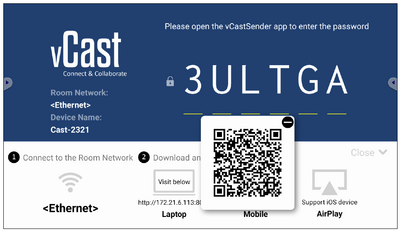
- To connect to the display, input the PIN code and click OK.
- Additionally, you can connect to the display by clicking Device List then the Device Name listed.


Casting from Android Devices

- Ensure the client device (e.g., Android phone or tablet) is connected to the same network as the display.
- On the Android client device, scan the QR code shown on the display to directly download the vCastSender application, or download the application from the Google Play Store.
- After installing, launch the vCastSender application.
- To connect to the display, input the PIN code and select OK.
- You can also connect to the display by clicking Device List then the Device Name listed.
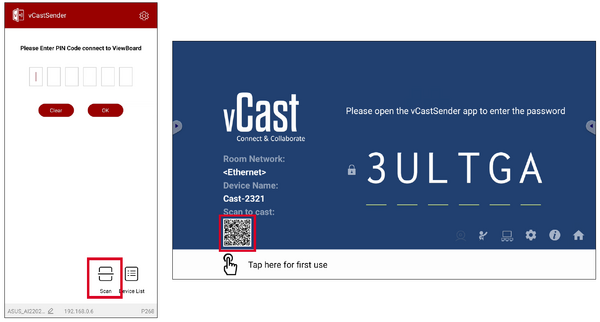
- Additionally, you can connect to the display by selecting Scan then placing the on-screen QR code into the box to automatically connect.


Casting from Apple iOS Devices
Apple AirPlay® is compatible with vCast for screen mirroring and content streaming under the same subnet environment only. An “AirPlay Password” will be generated on-screen for connection when using AirPlay to cast to a display.

- Ensure the client device (e.g., iPhone or iPad) is connected to the same network as the display.
- On the iOS client device, directly open AirPlay and select the Device Name of the display to connect.
- Input the generated on-screen AirPlay Password on the client device to connect.
- You can also connect to the display by selecting Scan then placing the on-screen QR code into the box to automatically connect.

Connecting to a Display from Mobile Device
Once connected, select Receive. The selected display screen will appear on the mobile device with an on-screen toolbar. Users can interact with the display with annotations, file sharing, etc.

| Item | Description | |
|---|---|---|
 |
Toggle | Hide or display the toolbar. |
 |
Home | Return to the Home interface. |
 |
Return | Return to the previous operation. |
 |
Folder | View or open the mobile device's files. |
 |
Share | Cast the mobile device's screen to the connected display. |
 |
Touch | Remotely control the connected display. |
 |
Annotate | Make annotations, and adjust the pen color. |
 |
Clear | Clear everything on screen. |
 |
Camera | Send camera images to the connected display. |
Casting with Chromecast
vCast supports native Chromecast screen sharing via the Chrome browser casting when the Chromecast feature is enabled.
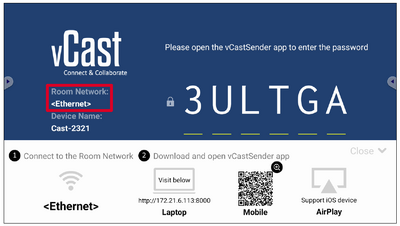
- Ensure the client device (e.g., laptop) is connected to the same network as the display.
Note: The network name can be found under Room Network.
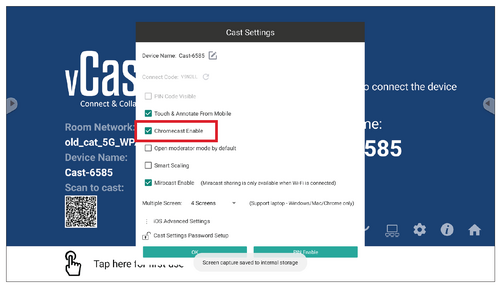
- Ensure the Chromecast Enable checkbox is selected in the vCast settings.
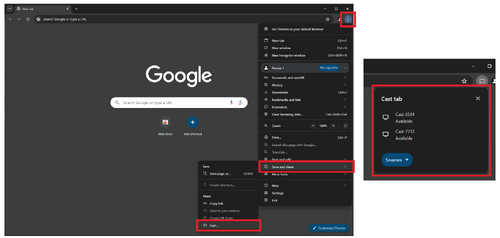
- In the Chrome browser, go to: Settings > Save and share > Cast... > Select the screen to cast to.


Casting with Miracast
vCast supports native Miracast to cast content from Windows and Android devices to a display when the Miracast feature is enabled.
- Miracast does not support password protection or multiple-screen casting.
- Miracast sharing is only available over Wi-Fi.
- Miracast will automatically turn off after being idle for one hour.
- Ensure the client device (e.g., laptop) is connected to the same network as the display.
Note: The network name can be found under Room Network.
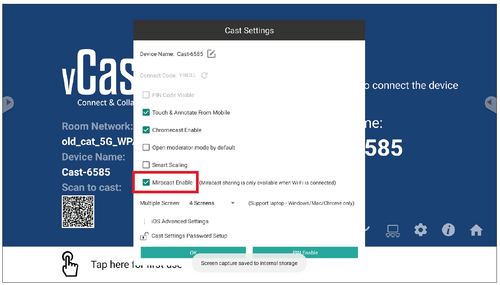
- Ensure the Miracast Enable checkbox is selected in the vCast settings.
- Please follow the below steps to cast:
For Windows devices:
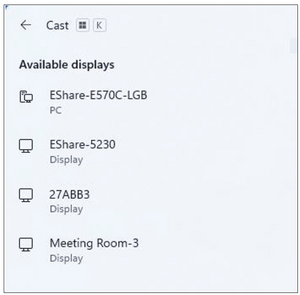
- On the Windows device, press Win + K and select the display to cast to.
- Select the checkbox “Allow mouse, keyboard, touch, and pen input from the device” to enable the touch feedback feature.
For Android devices:
On the Android device, directly select Cast/Smart View/Wireless Projection then select the display to cast to. - On the Windows device, press Win + K and select the display to cast to.


Other Default Applications
Browser
Web browser for surfing the internet.

Office Suite
Create, edit, and view Documents, Spreadsheets, Presentations, and PDFs.


vSweeper
Clear unnecessary data and unwanted files.

Advanced Settings can also be customized to the user's needs.
