


| Sub-menu |
|---|
| HDMI 1 |
| HDMI 2 |
| DisplayPort |
VA1655-3
From ViewSonic Documentation
Introduction
Package Contents
- Portable display
- Power adapter (optional)
- USB Type C cable
- USB Type C to Type A cable (optional)
- Mini HDMI to HDMI cable
- Quick start guide
Note: The cables included in your package may vary depending on your country. Please contact your local reseller for more information.
Product Overview
-
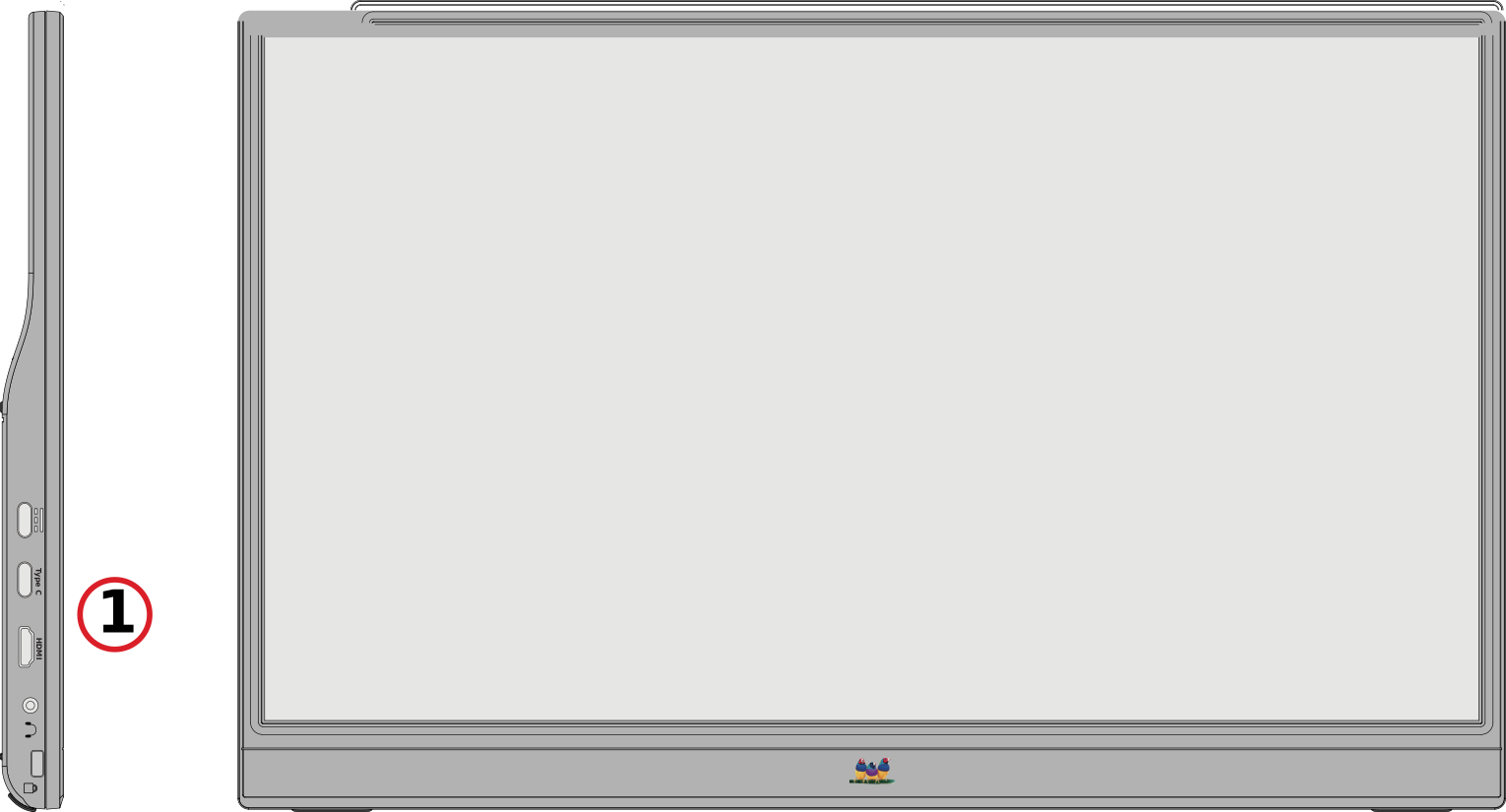 Front View
 -
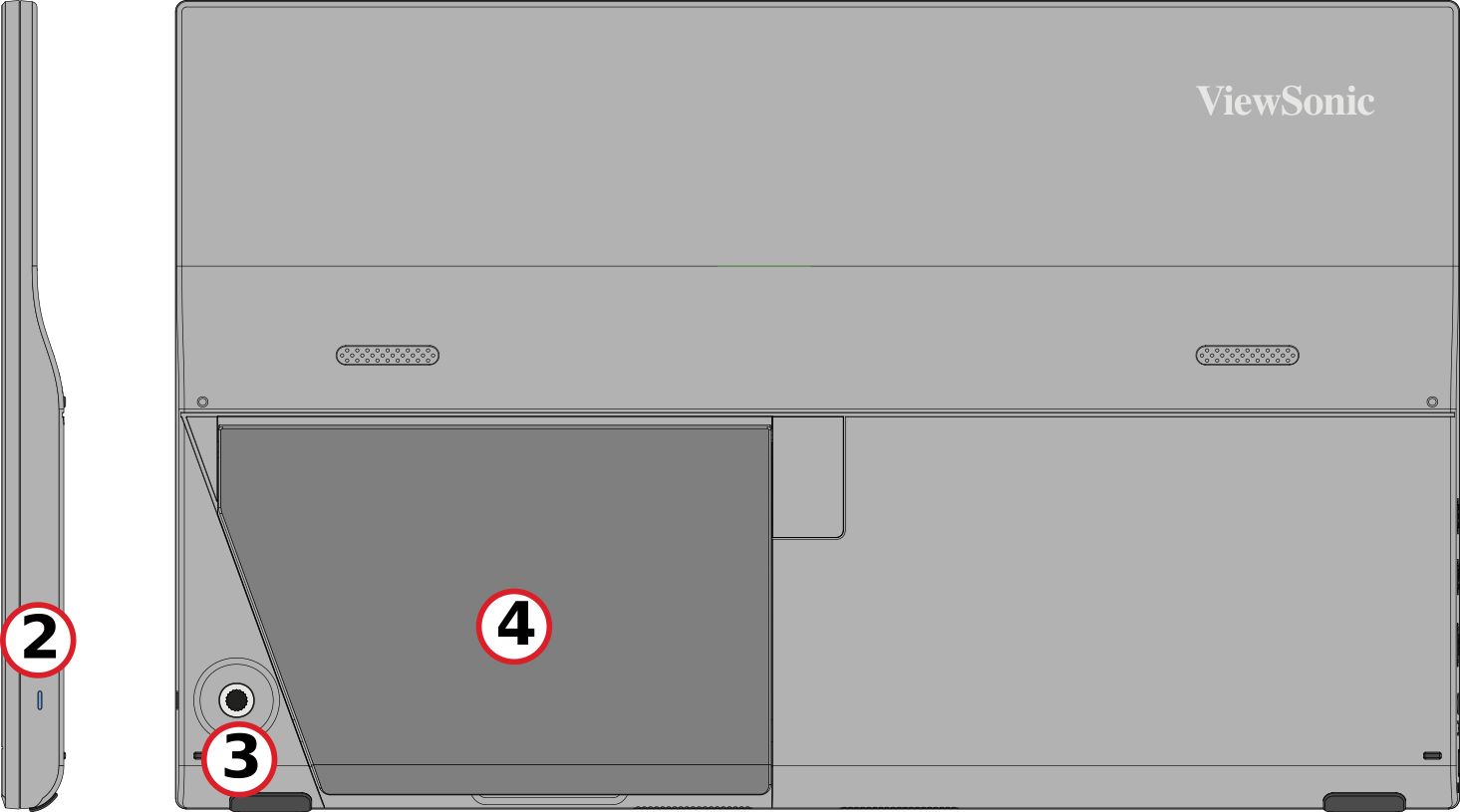 Rear View
| Number | Description |
|---|---|
| 1 | I/O Ports |
| 2 | Power LED |
| 3 | Joy Key |
| 4 | Stand |
I/O Ports

| Number | Description |
|---|---|
| 1 | USB Type C |
| 2 | USB Type C |
| 3 | Mini HDMI |
| 4 | Audio Out |
Note: For more information about the Joy Key, refer to Using the Joy Key.
Initial Setup
Tilt Angle Adjustment
Tilt the monitor backwards to the desired viewing angle by using the attached stand (30˚ to 53˚).

Note: When adjusting, support the monitor firmly with one hand while tilting the stand backwards with the other hand.
Using the Stand

Note: Place the monitor on a flat, stable surface to ensure safety and optimal performance.
Making Connections
Connecting to Power
The monitor can be powered in any of the following configurations:

Connecting to External Devices
Your external device(s) can be connected in any of the following configurations:
Type C Connection
Connect a Type C cable from your external device to a Type C port on the monitor.

Mini HDMI Connection
- Connect the mini HDMI cable from your external device to the mini HDMI port on the monitor.
- Connect the USB Type A to Type C cable from your external device.

Note: The USB Type A to Type C connection will also supply power to the monitor from the laptop. The power output must be greater than 10W.
Using the Monitor
Adjusting the Viewing Angle
Height Adjustment
Lower or raise the monitor (0 to 130 mm).

Note: When adjusting, hold the monitor firmly on both sides and press down along the adjustment track.
Screen Orientation Adjustment (Monitor Pivot)
 |
 |
 |
- Raise the monitor to its maximum height and then tilt it back fully.
- Rotate the monitor 90° clockwise or counterclockwise from landscape to portrait orientation.
- When adjusting, hold the monitor firmly on both sides.
- To rotate the screen image, manually change the system’s display orientation settings.
Note:
Swivel Angle Adjustment
Turn the monitor to the left or right (± 45˚).

Tilt Angle Adjustment
Tilt the monitor forwards or backwards (-5˚ to 22˚).

Note: Adjust the monitor by supporting the stand with one hand and gently tilting the screen with the other.
Turning the Monitor On/Off
Note:

- Plug the connected power adapter into a power outlet.
- Press the Power ( ) button to turn on the monitor.
- To turn the monitor off, press the Power ( ) button again.
- The monitor will still consume power as long as the power cord is plugged in. If the monitor is not being used for extended periods, please unplug the power cord from the power outlet.
- If the OSD Menu is still on screen, press and hold the Power ( ) button for three seconds to turn the monitor off.
Note:
Using the Control Panel Keys
Activate Hot Keys, navigate the On-Screen Display (OSD) Menu, and change settings.

Quick Menu
Press the 1 (★) key to activate the Quick Menu

Note: Follow the key guide that appears on the screen to select the option or make adjustments.
| Icon | Menu | Description |
|---|---|---|

|
ViewMode | Select one of the preset color settings. |

|
Volume | Adjust the level, or mute the volume. |

|
Contrast/Brightness | Adjust the contrast or brightness level. |

|
Input Select | Select the input source. |

|
Exit | Exit the Quick Menu. |
Hot Keys
When the On-Screen Display (OSD) Menu is off, you can quickly access special functions by using the Control Panel Keys.
| Key | Description |
|---|---|
| 1(★) + 2 | Press and hold the keys to lock/unlock the OSD Menu.
When the menu appears on the screen, continue holding both keys for 10 seconds to lock/unlock the OSD Menu.  If the OSD Menu is locked, the below message will appear on the screen:  |
| 2 + 3 | Press and hold the keys to lock/unlock the Power ( ) button.
When the menu appears on the screen, continue holding the key for 10 seconds to lock/unlock the Power ( ) button.  If the Power ( ) button is locked, the below message will appear on the screen:  |
| 3 + 4 | Press the keys to display/hide the Boot up Screen when the monitor is turned on.
 |
Configuring the Settings
General Operations
- Press the 2/3/4 key to display the On-Screen Display (OSD) Menu.
- Press the 1(★) or 2 key to select the main menu. Then press the 3 key to enter the selected menu.
- Press the 1(★) or 2 key to select the desired menu option. Then press the 3 key to enter the sub-menu.
- Press the 1(★) or 2 key to adjust/select the setting. Then press the 3 key to confirm.
- Press the 4 key to return to the previous menu.


Note: Certain menu option adjustments do not require the user to press the 3 key to confirm the selection. Follow the key guide that appears on the screen to select the option or make adjustments.
Appendix
Specifications
| Item | Category | Specifications |
|---|---|---|
| LCD | Type | IPS type, a-si TFT Active Matrix 1920 x 1080 LCD, 0.3108 (H) mm x 0.3108 (V) mm pixel pitch |
| Display Size | 68.58 cm | |
| 27" viewable | ||
| Color Filter | RGB Vertical Stripe | |
| Glass Surface | Anti-Glare (Haze 25%), Hard Coating (3H) | |
| Input Signal | Video Sync | TMDS digital (100 Ω)
|
| Compatibility | PC | up to 1920 x 1080 |
| Macintosh | up to 1920 x 1080 | |
| Resolution and Timings[1] | Recommended | 1920 x 1080 @ 60 Hz |
| Supported |
| |
| Power[3] | Input Voltage | AC 100-240V, 50/60 Hz (auto switch) |
| Display Area | Active Size (H x V) |
596.74 x 335.66 mm |
| 23.49" x 13.21" | ||
| Operating Conditons | Altitude | 3.048 km |
| 10,000 ft | ||
| Relative Humidity | 20% to 90% (non-condensing) | |
| Temperature | 0° C to 40° C | |
| 32° F to 104° F | ||
| Storage Conditions | Altitude | 12 km |
| 39,370.1 ft | ||
| Relative Humidity | 5% to 90% (non-condensing) | |
| Temperature | -20° C to 60° C | |
| -4° F to 140° F | ||
| Dimensions
(with stand) |
Physical (W x H x D) |
615 x 528~398 x 228 mm |
| 24.2" x 20.7"~15.6" x 8.9" | ||
| Weight
(with stand) |
Physical | 5.6 kg |
| 12.3 lb | ||
| Dimensions
(without stand) |
Physical (W x H x D) |
615 x 363.8 x 46 mm |
| 24.2" x 14.3" x 1.8" | ||
| Weight
(without stand) |
Physical (W x H x D) |
3.7 kg |
| 8.0 lb | ||
| Wall Mount | Dimensions | 100 x 100 mm |
| Power Consumption | On[4] | 30W (Typical) |
| Standby | < 0.5W (Maximum) | |
| Off | < 0.3W (Maximum) |
- ↑ Do not set the graphics card in your computer to exceed these timing modes; doing so may result in permanent damage to the display.
- ↑ 2.0 2.1 Available when Overclocking is turned on in the OSD Menu.
- ↑ Please use the power adapter/power cord from ViewSonic® or an authorized source only.
- ↑ The test condition follows EEI standards.
On-Screen Display (OSD) Menu Tree
| Sub-menu | Menu Option |
|---|---|
| Volume | (-/+, 0~100)/1 |
| Sub-menu |
|---|
| Standard |
| FPS Game |
| RTS Game |
| MOBA Game |
| Movie |
| Web |
| Text |
| MAC |
| Mono |
| Sub-menu | Menu Option | ||
|---|---|---|---|
| Contrast/Brightness | Contrast | (-/+, 0~100)/1 | |
| Brightness | (-/+, 0~100)/1 | ||
| Color Temperature | sRGB | ||
| Bluish | |||
| Cool | |||
| Native | |||
| Warm | |||
| User Color | Red | (-/+, 0~100)/1 | |
| Green | (-/+, 0~100)/1 | ||
| Blue | (-/+, 0~100)/1 | ||
| Color Space | Auto | ||
| RGB | |||
| YUV | |||
| Color Range | Auto | ||
| Full Range | |||
| Limited Range | |||
| Sub-menu | Menu Option |
|---|---|
| Sharpness | (-/+, 0~100)/25 |
| Blue Light Filter | (-/+, 0~100)/1 |
| Aspect Ratio | 4:3 |
| 5:4 | |
| 16:9 | |
| 16:10 | |
| Overscan | On |
| Off | |
| Black Stabilization | (-/+, 0~100)/10 |
| Advanced DCR | (-/+, 0~100)/25 |
| Response Time | Standard |
| Advanced | |
| Ultra Fast |
| Sub-menu | Menu Option |
|---|---|
| Language | English |
| Français | |
| Deutsch | |
| Español | |
| Italiano | |
| Suomi | |
| Svenska | |
| Русский | |
| Türkçe | |
| Česká | |
| Tiếng Việt | |
| 日本語 | |
| 한국어 | |
| 繁體中文 | |
| 简体中文 | |
| Adaptive Sync | On |
| Off | |
| HDR | On |
| Off | |
| 1ms Mode | On |
| Off | |
| Overclocking | On |
| Off | |
| OSD Pivot | 90° |
| 270° | |
| Off | |
| Information | |
| OSD Timeout | (-/+, 5/15/30/60) |
| OSD Background | On |
| Off | |
| Power Indicator | On |
| Off | |
| Auto Power Off | On |
| Off | |
| Sleep | 30 minutes |
| 45 minutes | |
| 60 minutes | |
| 120 minutes | |
| Off | |
| ECO Mode | Standard |
| Optimize | |
| Conserve | |
| DisplayPort 1.1 | On |
| Off | |
| Auto Detect | On |
| Off | |
| DDC/CI | On |
| Off | |
| Memory Recall |
XG2709A_UG_ENG_1a_20241014