


| Sub-menu |
|---|
| HDMI |
| DisplayPort |
| Type C |
VG3419C
From ViewSonic Documentation
Package Contents
|
 |
Front View / Rear View
 |
 |
| Front View | Rear View |
| Letter | Item |
|---|---|
| A | Display Screen |
| B | Control Panel Keys |
| C | Joy Key |
| D | Security Slot |
I/O Ports

| Number | Item |
|---|---|
| 1 | AC IN |
| 2 | HDMI |
| 3 | DisplayPort |
| 4 | USB Type C |
| 5 | LAN |
| 6 | USB Upstream |
| 7 | USB Downstream |
| 8 | Audio Out |
Installing the Stand

- NOTE: Always place the device on a flat, stable surface. Failure to do so may cause the device to fall and damage the device and/or result in personal injury.
Removing the Stand and Mounting the Display
For use only with a UL certified mounting kit/bracket. To obtain a wall mounting kit or height adjustment base, contact ViewSonic® or your local dealer.
Refer to the table below for the standard dimensions for mounting kits.
| Maximum Loading | Hole Pattern (W x H) | Interface Pad (W x H x D) | Pad Hole | Screw Specification | Screw Quantity |
|---|---|---|---|---|---|
| 14 kg | 100 x 100 mm | 115 x 115 x 2.6 mm | Ø 5 mm | M4 x 10 mm | 4 screws |
- NOTE: Mounting kits are sold separately.

- Turn off the device and disconnect all cables.
- Place the device on a flat, stable surface with the screen facing down.
- Remove the monitor stand.
- Attach the mounting bracket to the VESA mounting holes at the rear of the monitor. Then secure it with four (4) screws (M4 x 10 mm).
- Follow the instructions that come with the mounting kit to mount the monitor.
Using the Security Slot
To help prevent the device from being stolen, use a security slot locking device to secure the device to a fixed object.
Additionally, fastening the monitor to a wall or fixed object using a security cable can help support the weight of the monitor in order to prevent the monitor from falling over.
Below is an example of setting up a security slot locking device on a table.

Connecting to Power

- Connect the power cord to the AC IN jack at the rear of the device.
- Plug the power cord plug into a power outlet.
Connecting External Devices
HDMI Connection
Connect one end of an HDMI cable to the HDMI port of your monitor. Then connect the other end of the cable to the HDMI port of your computer.

DisplayPort Connection
Connect one end of a DisplayPort cable to the DisplayPort port. Then connect the other end of the cable to the DisplayPort or mini DP port of your computer.
- NOTE: To connect the monitor to the Thunderbolt port (v. 1&2) on your Mac, connect the mini DP end of the “mini DP to DisplayPort cable” to the Thunderbolt output of your Mac. Then connect the other end of the cable to the DisplayPort port of the monitor.

USB Connection
Connect one end of a USB cable to a USB port of the monitor. Then connect the other end of the cable to a USB port of your computer.
- NOTE: The monitor supports three (3) types of USB ports. When making the connection(s), observe the following guidelines:
| USB Type | Quantity | Description |
|---|---|---|
| Type A | 3 | Connection for your Type A peripheral device(s) (e.g., storage device, keyboard, mouse).
|
| Type B | 1 | Connect the USB Type B male cable (square with 2 cut corners) to this port, and then connect the other end of the cable to the USB downstream port of your computer. |
| Type C | 1 | Make sure your Type C output device and cable support video signal transmission for video display.
|

- NOTE: It is not necessary to connect to all two types of USB ports at the same time. The user’s personal usage scenario will determine which, if any, USB ports are used.
Audio Connection
Plug the audio jack of the ear-/headphones into the Audio Out port of the monitor. Additionally, you can connect the monitor to a sound bar using an audio cable.

Ethernet Connection
Connect one end of your LAN (RJ45) cable to the LAN (RJ45) port of the monitor. Then connect the other end to your network.

Next, you must connect your computer to the monitor by either:
- USB Type C

- HDMI and USB Upstream
- DisplayPort and USB Upstream

OR

Height Adjustment
Lower or raise the monitor to the desired height (0 to 150 mm).

- NOTE: When adjusting, press down firmly along the adjustment track.
Tilt Angle Adjustment
Tilt the monitor forwards or backwards to the desired viewing angle (-3.5° to 23°).

- NOTE: When adjusting, support the monitor firmly with one hand while tilting the stand backwards with the other hand.
Turning the Device ON/OFF

- Plug the power cord into a power outlet.
- Press the Power button to turn on the monitor.
- To turn the monitor off, press the Power button again. NOTE: The monitor will still consume some power as long as the power cord is connected to the power outlet. If the monitor is not being used for a long period of time, please disconnect the power plug from the power outlet.
Using the Control Panel Keys
Use the control panel keys to access the Quick Menu, activate Hot Keys, navigate the On-Screen Display (OSD) Menu, and change the settings.

Input Select
Press the Input Select  key to select an input source.

Volume
Press the Volume Up  or Volume Down
  key to adjust the volume level.

Main Menu
Press or move the Joy Key to enter the On-Screen Display (OSD) Menu.

Exit
Press the Input Select key to exit the Main Menu.
Hot Keys
When the On-Screen Display (OSD) Menu is off, you can quickly access special functions by using the Joy Key.
| Key | Description |
|---|---|
 |
Press and hold the key to lock/unlock the OSD Menu.
When the menu appears on the screen, continue holding the key for 10 seconds to lock/unlock the OSD Menu.  If the OSD Menu is locked, the below message will appear on the screen:  |
 |
Press and hold the key to lock/unlock the Power button.
When the menu appears on the screen, continue holding the key for 10 seconds to lock/unlock the Power button.  If the Power button is locked, the below message will appear on the screen:  |
 |
Press and hold the key to display/hide the boot up screen when the device is turned on.
 |
General Operation
- Press or move the Joy Key to display the On-Screen Display (OSD) Menu.
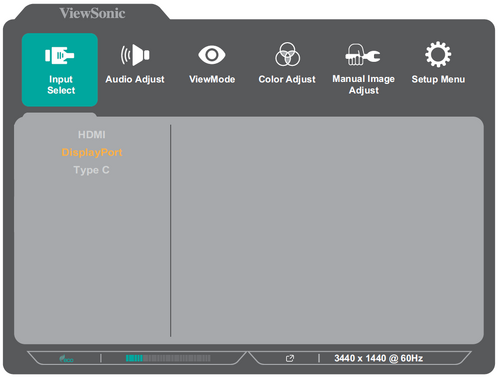
- Move the Joy Key
 or
or  to select the main menu. Then press the Joy Key
  to enter the selected menu.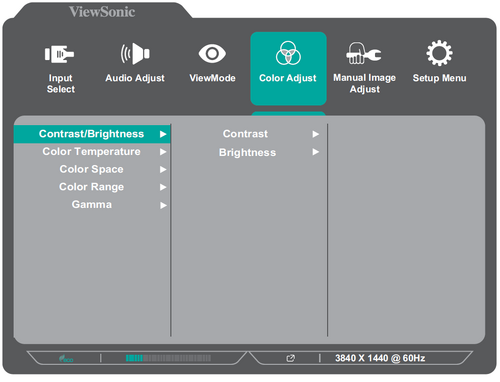
- Move the Joy Key
 or
or  to select the desired menu option. Then press the Joy Key to to enter the sub-menu.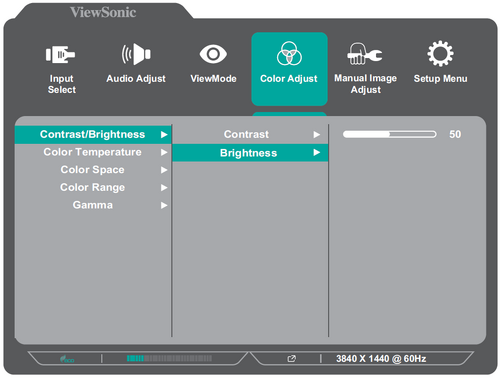
- Move the Joy Key or to select the setting. Then press the Joy Key to confirm. Or move the Joy Key or to make adjustments.
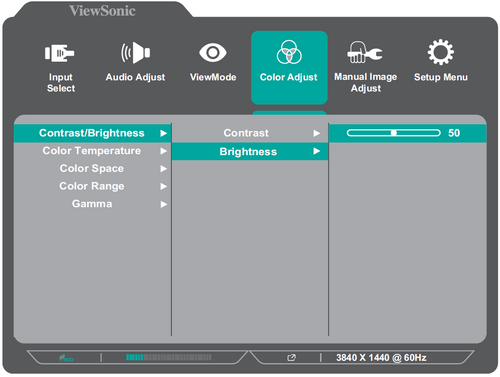
- To return to the previous menu:
- Press the Input Select key .
- Move the Joy Key .
- When scrolling move the Joy Key or .
On-Screen Display (OSD) Menu Tree
| Sub-menu | Menu Option |
|---|---|
| Volume | (-/+, 0~100) |
| Mute | On |
| Off |
| Sub-menu | Menu Option | |||
|---|---|---|---|---|
| Off | ||||
| Office | Web | |||
| Text | ||||
| Custom 1/2/3 | Low Input Lag | On/Off | ||
| Black Stabilization | (-/+, 0/10/20/30/40/50/60/70/80/90/100) | |||
| Advanced DCR | (-/+, 0/25/50/75/100) | |||
| Response Time | Standard | |||
| Advanced | ||||
| Ultra Fast | ||||
| Hue | Red | (-/+, 0~100) | ||
| Green | (-/+, 0~100) | |||
| Blue | (-/+, 0~100) | |||
| Cyan | (-/+, 0~100) | |||
| Magenta | (-/+, 0~100) | |||
| Yellow | (-/+, 0~100) | |||
| Saturation | Red | (-/+, 0~100) | ||
| Green | (-/+, 0~100) | |||
| Blue | (-/+, 0~100) | |||
| Cyan | (-/+, 0~100) | |||
| Magenta | (-/+, 0~100) | |||
| Yellow | (-/+, 0~100) | |||
| Rename | ||||
| Recall | ||||
| Movie | ||||
| MAC | ||||
| Mono | ||||
| Game | FPS 1 | |||
| FPS 2 | ||||
| RTS | ||||
| MOBA | ||||
| Sub-menu | Menu Option | ||
|---|---|---|---|
| Contrast/Brightness | Contrast | (-/+, 0~100) | |
| Brightness | (-/+, 0~100) | ||
| Color Temperature | Bluish | ||
| Cool | |||
| Native | |||
| Warm | |||
| User Color | Red | (-/+, 0~100) | |
| Green | (-/+, 0~100) | ||
| Blue | (-/+, 0~100) | ||
| Color Space | Auto | ||
| RGB | |||
| YUV | |||
| Color Range | Auto | ||
| Full Range | |||
| Limited Range | |||
| Gamma | 1.8 | ||
| 2.0 | |||
| 2.2 | |||
| 2.4 | |||
| 2.6 | |||
| 2.8 | |||
| Sub-menu | Menu Option |
|---|---|
| Sharpness | (-/+, 0/25/50/75/100) |
| Blue Light Filter | (-/+, 0~100) |
| Aspect Ratio | 4:3 |
| Full Screen | |
| Overscan | On |
| Off |
| Sub-menu | Menu Option | |
|---|---|---|
| Language | English | |
| Français | ||
| Deutsch | ||
| Español | ||
| Italiano | ||
| Suomi | ||
| Русский | ||
| Türkçe | ||
| Česká | ||
| Tiếng Việt | ||
| 日本語 | ||
| 한국어 | ||
| 繁體中文 | ||
| 简体中文 | ||
| FreeSync Premium | On | |
| Off | ||
| HDR | Auto | |
| Off | ||
| MPRT | On | |
| Off | ||
| Resolution Notice | On | |
| Off | ||
| Information | ||
| OSD Timeout | (-/+, 5/15/30/60) | |
| OSD Background | On | |
| Off | ||
| Power Indicator | On | |
| Off | ||
| Auto Power Off | On | |
| Off | ||
| Sleep | 30 minutes | |
| 45 minutes | ||
| 60 minutes | ||
| 120 minutes | ||
| Off | ||
| ECO Mode | Standard | |
| Optimize | ||
| Conserve | ||
| Energy Saving | On | |
| Off | ||
| USB Charging | On | |
| Off | ||
| DisplayPort 1.2 | On | |
| Off | ||
| USB 3.2 | On | |
| Off | ||
| KVM | Auto | |
| USB-B | ||
| USB-C | ||
| DDC/CI | On | |
| Off | ||
| Auto Detect | On | |
| Off | ||
| All Recall | ||
- NOTE:
- KVM: When two computers are connected to the monitor, the KVM function allows for seamless device sharing between the two computers. This feature enables you to share devices like a USB-connected keyboard and mouse set by simply switching the input source.
- ECO Mode - USB Charging: This function is recommended to be ON to enable USB-C in Power Saving mode.
KVM Function

- Auto:When you connect two computers to the monitor, one using an HDMI (or DP) cable with a USB cable for data upstream, and the other using USB-C for signal and data connection, you can easily switch input signals and use the same mouse and keyboard set between the two computers.
- USB-B & USB-C:When you connect two computers to a monitor using HDMI and DP cables, with a USB cable and USB-C to A cable for data upstream, you will need to configure the data upstream method for each input source individually. Once this setup is properly established, you can easily switch between input signals and use the same mouse and keyboard set between the two computers.

Technical Specifications
| Item | Category | Specifications |
|---|---|---|
| Model | P/N. | VG3419C |
| No. | VS19725 | |
| LCD | Type | a-Si TFT Active Matrix 3440 x 1440 LCD;
0.23 (H)mm x 0.23 (V)mm pixel pitch |
| Display Size | 86.4 cm (34" viewable) | |
| Color Filter | RGB vertical stripe | |
| Glass Surface | Anti-Glare (Haze 25%), Hard Coating (3H) | |
| Input Signal | Video Sync |
TMDS digital (100 Ω)
|
| Compatibility | PC | up to 3440 x 1440 |
| Macintosh | up to 3440 x 1440 | |
| Resolution[1] | Recommended | 3440 x 1440 @ 60Hz |
| Supported |
| |
| Power[4] | Input Voltage | AC 100-240V, 50/60Hz (auto switch) |
| Display Area | Full Scan (H x V) |
797.22 x 333.72 mm
(31.39” x 13.14”) |
| Operating Conditons | Temperature | 0° C to 40° C (32° F to 104° F) |
| Humidity | 20% to 90% (non-condensing) | |
| Altitude | 16,000 feet (5 km) | |
| Storage Conditions | Temperature | -20° C to 60° C (-4° F to 140° F) |
| Humidity | 5% to 90% (non-condensing) | |
| Altitude | 40,000 feet (12.1 km) | |
| Dimensions | Physical (W x H x D) |
809 x 593 x 269 mm
(31.9” x 23.3” x 10.6”) |
| Wall Mount | Dimensions | 100 x 100 mm |
| Weight | Physical | 10.6 kg (23.4 lbs) |
| Power Saving Modes | On[5] | 168W (Typical) |
| Off | ≤ 0.3W (Max) |
- ↑ Do not set the graphics card in your computer to exceed these timing modes; doing so may result in permanent damage to the display.
- ↑ Disclaimer: When displaying 3440 x 1440 @ 75/100/120Hz resolution via USB-C, if USB-C 3.2 is set to “ON”, the video input will only support YCbCr 4:2:2 format, please check if your graphics card supports it. If USB-C 3.2 is set to “OFF”, the video input can support RGB format, but data transfer & Ethernet speed will be limited to USB 2.0 due to bandwidth limitation.
- ↑ Timing: 3440 x 1440 @ 120Hz is only available for DisplayPort and USB-C inputs.
- ↑ Please use the power adapter from ViewSonic® or an authorized source only.
- ↑ The test condition follows EEI standards.
 |
The terms HDMI, HDMI High-Definition Multimedia Interface, HDMI trade dress and the HDMI Logos are trademarks or registered trademarks of HDMI Licensing Administrator, Inc. |
Compliance Information
This section addresses all connected requirements and statements regarding regulations. Confirmed corresponding applications shall refer to nameplate labels and relevant markings on the unit.
FCC Compliance Statement
This device complies with part 15 of FCC Rules. Operation is subject to the following two conditions: (1) this device may not cause harmful interference, and (2) this device must accept any interference received, including interference that may cause undesired operation. This equipment has been tested and found to comply with the limits for a Class B digital device, pursuant to part 15 of the FCC Rules.
These limits are designed to provide reasonable protection against harmful interference in a residential installation. This equipment generates, uses, and can radiate radio frequency energy, and if not installed and used in accordance with the instructions, may cause harmful interference to radio communications. However, there is no guarantee that interference will not occur in a particular installation. If this equipment does cause harmful interference to radio or television reception, which can be determined by turning the equipment off and on, the user is encouraged to try to correct the interference by one or more of the following measures:
- Reorient or relocate the receiving antenna.
- Increase the separation between the equipment and receiver.
- Connect the equipment into an outlet on a circuit different from that to which the receiver is connected.
- Consult the dealer or an experienced radio/TV technician for help.
Warning: You are cautioned that changes or modifications not expressly approved by the party responsible for compliance could void your authority to operate the equipment.
Industry Canada Statement
CAN ICES-003(B) / NMB-003(B)
CE Conformity for European Countries
 |
The device complies with the EMC Directive 2014/30/EU and Low Voltage Directive 2014/35/EU. |
The following information is only for EU-member states:
| The mark shown to the right is in compliance with the Waste Electrical and Electronic Equipment Directive 2012/19/EU (WEEE). The mark indicates the requirement NOT to dispose of the equipment as unsorted municipal waste, but use the return and collection systems according to local law. |  |
Declaration of RoHS2 Compliance
This product has been designed and manufactured in compliance with Directive 2011/65/EU of the European Parliament and the Council on restriction of the use of certain hazardous substances in electrical and electronic equipment (RoHS2 Directive) and is deemed to comply with the maximum concentration values issued by the European Technical Adaptation Committee (TAC) as shown below.
| Substance | Proposed Maximum Concentration | Actual Concentration |
|---|---|---|
| Lead (Pb) | 0.1% | < 0.1% |
| Mercury (Hg) | 0.1% | < 0.1% |
| Cadmium (Cd) | 0.01% | < 0.01% |
| Hexavalent Chromium (Cr6⁺) | 0.1% | < 0.1% |
| Polybrominated biphenyls (PBB) | 0.1% | < 0.1% |
| Polybrominated diphenyl ethers (PBDE) | 0.1% | < 0.1% |
| Bis (2-ethylhexyl) phthalate (DEHP) | 0.1% | < 0.1% |
| Butyl benzyl phthalate (BBP) | 0.1% | < 0.1% |
| Dibutyl phthalate (DBP) | 0.1% | < 0.1% |
| Diisobutyl phthalate (DIBP) | 0.1% | < 0.1% |
Certain components of products as stated above are exempted under the Annex III of the RoHS2 Directives as noted below. Examples of exempted components are:
- Copper alloy containing up to 4% lead by weight.
- Lead in high melting temperature type solders (i.e. lead-based alloys containing 85% by weight or more lead).
- Electrical and electronic components containing lead in a glass or ceramic other than dielectric ceramic in capacitors, e.g. piezoelectronic devices, or in a glass or ceramic matrix compound.
- Lead in dielectric ceramic in capacitors for a rated voltage of 125 V AC or 250 V DC or higher.
Indian Restriction of Hazardous Substances
Restriction on Hazardous Substances statement (India). This product complies with the “India E-waste Rule 2011” and prohibits use of lead, mercury, hexavalent chromium, polybrominated biphenyls or polybrominated diphenyl ethers in concentrations exceeding 0.1 weight % and 0.01 weight % for cadmium, except for the exemptions set in Schedule 2 of the Rule.
Indian Restriction of Hazardous Substances
Restriction on Hazardous Substances statement (India). This product complies with the “India E-waste Rule 2011” and prohibits use of lead, mercury, hexavalent chromium, polybrominated biphenyls or polybrominated diphenyl ethers in concentrations exceeding 0.1 weight % and 0.01 weight % for cadmium, except for the exemptions set in Schedule 2 of the Rule.
Product Disposal at End of Product Life
ViewSonic® respects the environment and is committed to working and living green. Thank you for being part of Smarter, Greener Computing. Please visit the ViewSonic® website to learn more.
USA & Canada:
https://www.viewsonic.com/us/go-green-with-viewsonic
Europe:
https://www.viewsonic.com/eu/environmental-social-governance/recycle
Taiwan:
https://recycle.moenv.gov.tw/
For EU users, please contact us for any safety/accident issue experienced with this product:
 |
ViewSonic Europe Limited Flevolaan 38, 1382JZ, Weesp the Netherlands |
 |
+31 08000232999 |
 |
EPREL@viewsoniceurope.com |
 |
https://www.viewsonic.com/eu/ |
Copyright Information
Copyright© ViewSonic® Corporation, 2023. All rights reserved.
Macintosh and Power Macintosh are registered trademarks of Apple Inc.
Microsoft, Windows, and the Windows logo are registered trademarks of Microsoft Corporation in the United States and other countries.
ViewSonic® and the three birds logo are registered trademarks of ViewSonic® Corporation.
VESA is a registered trademark of the Video Electronics Standards Association. DPMS, DisplayPort, and DDC are trademarks of VESA.
Disclaimer: ViewSonic® Corporation shall not be liable for technical or editorial errors or omissions contained herein; nor for incidental or consequential damages resulting from furnishing this material, or the performance or use of this product.
In the interest of continuing product improvement, ViewSonic® Corporation reserves the right to change product specifications without notice. Information in this document may change without notice.
No part of this document may be copied, reproduced, or transmitted by any means, for any purpose without prior written permission from ViewSonic® Corporation.
VG3419C_UG_ENG_1a_20230726