


| Sub-menu | Menu Option |
|---|---|
| Brightness | (-/+, 0~100) |
| Contrast | (-/+, 0~100) |
| Eco Mode | Standard |
| Text | |
| Game | |
| Movie | |
| EyeSaver | |
| DCR | On |
| Off |
GD1330
From ViewSonic Documentation
Package Contents
|
 |
- NOTE: The power cord and video cables included in your package may vary depending on your country. Please contact your local reseller for more information.
System Requirements
Operating System:
- PC: Windows 7/8/10/11
- Mac: macOS X 10.15 and above
CPU:
- Pentium 233 MHz or above
Memory:
- 64 MB or above
Hard Disk Space:
- 128 MB or above
Interface:
- HDMI and USB interface
- Full function USB Type C or Thunderbolt 3 interface
Product Overview
Font and Side View

| Number | Item |
|---|---|
| 1 | Express Keys |
| 2 | I/O Ports |
| 3 | LED Indicator |
| 4 | Power Key |
| 5 | Menu Key |
I/O Ports

| Number | Item |
|---|---|
| 1 | Mini HDMI |
| 2 | USB Type C |
| 3 | USB Type C |
Connecting to the Pen Display
The pen display can be connected to a computer by either HDMI and USB Type C, or only USB Type C.
HDMI and USB Type C
- Ensure the power of the computer and pen display are off before connecting them.
- Connect one end of the HDMI cable to the HDMI port of your computer. Then connect the Mini HDMI end of the cable to the Mini HDMI port of the pen display.
- Connect the USB Type A end of the USB cable to your computer. Then connect the USB Type C end to the pen display.
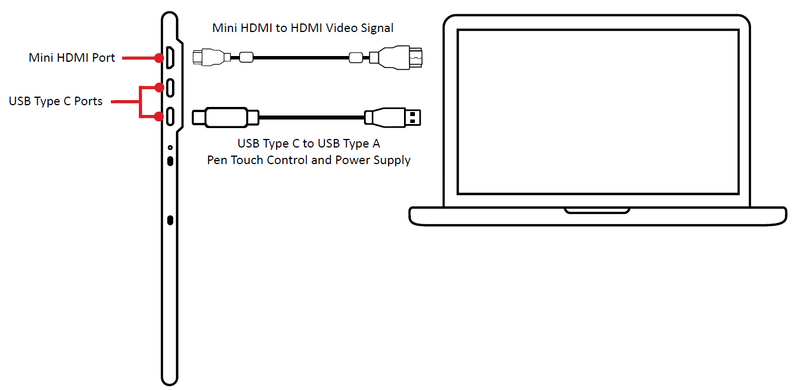
- NOTE: If connected to a desktop computer, and a monitor was already connected to the computer itself, then the tablet and monitor must be connected to the same graphics card of the desktop computer.
USB Type C
- Ensure your computer is equipped with a full function USB Type C interface or Thunderbolt 3 interface.
- Connect one end of the double-sided USB Type C cable to the USB Type C port of the pen display. Then connect the other end to the USB Type C port of the computer.
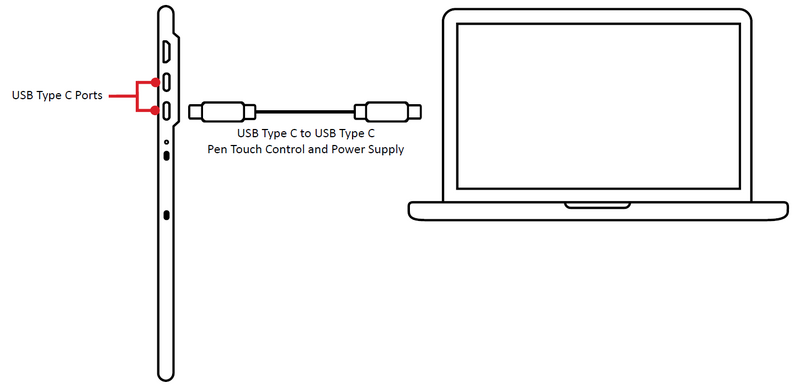
- NOTE: If the power supply from the USB Type C port of the computer is insufficient, the screen of the pen display might flash. In this case, connect a USB Type C to USB Type A cable to the USB Type C power supply port of the pen display, and connect the other end of the USB cable to the computer or a USB power adapter to ensure that sufficient power is supplied to the pen display.
Installing Drivers and Software (Windows)
- System Requirements: Windows 7/8/10 or above.
- Before connecting and using the pen display, it is necessary to install the below drivers and software. The drivers and software can be downloaded at: https://www.viewsonicglobal.com/q/GD1330
ViewSonic Pen Manager
- Open the installation file and install the driver.
- After the installation completes, you will need to restart the computer.
Uninstalling the Driver
There are two ways to uninstall the driver:
- Start > ViewSonic Pen Manager > Right Mouse Click > Uninstall
- Open the Control Panel > Programs > Programs and Features > ViewSonic Pen Manager > select Uninstall/Change
Installing Drivers and Software (macOS X)
- System Requirements: 10.15 or above.
- Before connecting and using the pen display, it is necessary to install the below drivers and software. The drivers and software can be downloaded at: https://www.viewsonicglobal.com/q/GD1330
Pen Display Driver
- Open the Pen Display Driver installation file, click Continue, then Install to begin installing the driver.
- During installation, you will need to enter your MacOS login information. After typing in your information, click Install Software.
- NOTE: For macOS version 10.14 and above, the system requires you to give privacy accessibility to allow the tablet driver to work.
- Click OK to allow Downloads folder file access.
- When the installation completes, choose to Keep the installation file or Move to Trash to remove it.
- After plugging in the Pen Display, the system will show the “Keystroke Receiving” interface. Click Open System Preferences.
- Go to: Privacy & Security > Input Monitoring > Toggle DigitizerDriver ON.
- Enter your MacOS login information and click Modify Settings.


Uninstalling the Driver
- Select: Go > Applications > Tablet Utility > Uninstall-Driver.app
- Click Yes when the system asks you to remove the driver.
- After uninstalling the driver, restart your Mac.


Setting the Display Area (Windows)
After the pen display is connected to the computer, the Display settings will need to be adjusted. To access the computer’s Display settings:
- Go to: Start > Settings > System > Display, or
- Right Click on the Desktop and select Display settings.
Once inside the Display settings, ensure the pen display is selected and:
- Display orientation is set to Landscape or Portrait (depending on your preference), and
- Multiple displays is set to Extend these displays.
Pen Input Settings (Windows)
To adjust the pen input settings:
- Open ViewSonic Pen Manager either by going to: Start > ViewSonic Pen Manager or selecting the ViewSonic Pen Manager icon from the System Tray.
- Adjustments to the pen can be made by selecting the Pen tab.
- Select the Mapping tab to adjust screen orientation and display.
- Select the Express Keys tab to customize the six (6) express keys on the pen display.


Pen Input Settings (macOSX)
To adjust the pen input settings:
- Open ViewSonic Pen Manager settings by clicking on the Settings icon.
- Click on ViewSonic Pen, then adjustments to the pen can be made by selecting the Pen tab.
- Select the Mapping tab to adjust screen orientation and display format.
- Select the Express Keys tab to customize the six (6) express keys on the pen display.


Turning the Device On/Off
- Ensure the display is connected properly to the computer.
- Press the Power key to turn on the display.
- To turn the display off, press the Power key again.
- NOTE: The display will still consume some power as long as it is connected. If the display is not being used for a long period of time, please disconnect it.
On-Screen Display (OSD) Menu
Press the Menu key to activate the On-Screen Display (OSD) Menu.

| Menu | Description | |
|---|---|---|
 |
Brightness | Adjust the contrast or brightness level. |
 |
Image | Manually set a variety of image quality adjustments. |
 |
Color Temperature | Select one of the preset color settings. |
 |
OSD Setting | Adjust On-Screen Display (OSD) settings. |
 |
Reset | Returns the adjustments back to factory settings. |
 |
Miscellaneous | Adjust the level, or mute the volume. Select the input source. |
Configuring the Settings
General Operations
- Press the Menu key to display the On-Screen Display (OSD) Menu.
- Press the ▼ or ▲ key to select the main menu. Then press the Menu key to enter the selected menu.
- Press the ▼ or ▲ key to select the desired menu option. Then press the Menu key to enter the sub-menu.
- Press the ▼ or ▲ key to adjust/select the setting. Then press the Menu key to confirm.
- NOTE: Certain menu option adjustments do not require the user to press the Menu key to confirm the selection.
On-Screen Display (OSD) Menu Tree
| Sub-menu | Menu Option |
|---|---|
| H. Position | (-/+, 0~100) |
| V. Position | (-/+, 0~100) |
| Clock | (-/+, 0~100) |
| Phase | (-/+, 0~100) |
| Aspect | Auto |
| Wide | |
| 4:3 |
| Sub-menu | Menu Option | ||
|---|---|---|---|
| Color Temperature | Warm | ||
| Normal | |||
| Cool | |||
| User | Red | (-/+, 0~100) | |
| Green | (-/+, 0~100) | ||
| Blue | (-/+, 0~100) | ||
| Low Blue Light Mode | On | ||
| Off | |||
| Sub-menu | Menu Option |
|---|---|
| Language | English |
| Français | |
| Deutsch | |
| 简体中文 | |
| Italiano | |
| Español | |
| Portuguese | |
| Türkçe | |
| Polish | |
| Dutch | |
| Русский | |
| 한국어 | |
| OSD H. Position | (-/+, 0~100) |
| OSD V. Position | (-/+, 0~100) |
| OSD Timeout | (-/+, 5~120) |
| Transparency | (-/+, 0/25/50/75/100) |
| Sub-menu |
|---|
| Image Auto Adjust |
| Color Auto Adjust |
| Reset |
| Auto Power Down |
| Sub-menu | Menu Option |
|---|---|
| Hot Key Type | ECO+DCR |
| BRI+CON | |
| ASP+ECO | |
| SOU+VOL | |
| Signal Source | VGA |
| DVI | |
| HDMI | |
| Mute | On |
| Off | |
| Volume | (-/+, 0~100) |
Technical Specifications
| Item | Category | Specifications |
|---|---|---|
| Model | P/N. | GD1330 |
| No. | VS18342 | |
| LCD | Type | TFT Active Matrix, 1920 x 1080 LCD |
| Display Size | 33.02 cm, (13") | |
| Surface Treatment | Hard-coating (8H) | |
| Resolution | Supported | 1920 x 1080 |
| Power | USB | DC 5V/2A, USB power supply |
| Operating Conditions | Temperature | 0° C to 40° C (32° F to 122° F) |
| Humidity | 20% to 80% (non-condensing) | |
| Storage Conditions | Temperature | -10° C to 60° C (14° F to 140° F) |
| Humidity | 10% to 90% (non-condensing) | |
| Dimensions | Physical (W x H x D) |
344 x 210 x 7 mm (13.54” x 8.27” x 0.28”) |
| Weight | Physical | 0.815 kg (1.8 lbs) |
| Power Consumption | On | 5W (Typical) |
| Standby | < 1W |
Pen
| Item | Specifications |
|---|---|
| Type | Electromagnetic resonance |
| Power Supply | Battery-less |
| Resolution | 5080 LPI (lines per inch) |
| Pressure Sensitivity | 8192 |
| Report Rate | Average 266 PPS (points per second) |
| Pen Tilt Angle | +/- 60° |
| OS Supported | Win10 (32/64 bit), Win8, Win 7, Win XP; macOS x 10.15 and above. |
Accessories
Pen Holder Stand
When not in use, the EM Pen can be stored in the Pen Holder Stand.

Additionally, Pen Nibs and the Nib Removal Tools can be stored inside the Pen Holder Stand. To open the Pen Holder Stand, rotate it anti-clockwise.

Drawing Glove
For better performance and smoothness when drawing on the display, you can wear the supplied Drawing Glove.

Replacing a Pen Nib
When the pen nib gets too short or develops a sharp edge, it can be replaced with spare nibs.

To replace a pen nib:
- Use the Nib Removal Tool to pull the old nib straight out of the pen.
- Insert a new pen nib into the pen and push the nib in until it stops and is held firm.


Compliance Information
This section addresses all connected requirements and statements regarding regulations. Confirmed corresponding applications shall refer to nameplate labels and relevant markings on the unit.
FCC Compliance Statement
This device complies with part 15 of FCC Rules. Operation is subject to the following two conditions: (1) this device may not cause harmful interference, and (2) this device must accept any interference received, including interference that may cause undesired operation. This equipment has been tested and found to comply with the limits for a Class B digital device, pursuant to part 15 of the FCC Rules.
These limits are designed to provide reasonable protection against harmful interference in a residential installation. This equipment generates, uses, and can radiate radio frequency energy, and if not installed and used in accordance with the instructions, may cause harmful interference to radio communications. However, there is no guarantee that interference will not occur in a particular installation. If this equipment does cause harmful interference to radio or television reception, which can be determined by turning the equipment off and on, the user is encouraged to try to correct the interference by one or more of the following measures:
- Reorient or relocate the receiving antenna.
- Increase the separation between the equipment and receiver.
- Connect the equipment into an outlet on a circuit different from that to which the receiver is connected.
- Consult the dealer or an experienced radio/TV technician for help.
Warning: You are cautioned that changes or modifications not expressly approved by the party responsible for compliance could void your authority to operate the equipment.
Industry Canada Statement
CAN ICES-003(B) / NMB-003(B)
CE Conformity for European Countries

The device complies with the EMC Directive 2014/30/EU and Low Voltage Directive 2014/35/EU.
The following information is only for EU-member states:

The mark shown to the right is in compliance with the Waste Electrical and Electronic Equipment Directive 2012/19/EU (WEEE). The mark indicates the requirement NOT to dispose of the equipment as unsorted municipal waste, but use the return and collection systems according to local law.
Declaration of RoHS2 Compliance
This product has been designed and manufactured in compliance with Directive 2011/65/EU of the European Parliament and the Council on restriction of the use of certain hazardous substances in electrical and electronic equipment (RoHS2 Directive) and is deemed to comply with the maximum concentration values issued by the European Technical Adaptation Committee (TAC) as shown below.
| Substance | Proposed Maximum Concentration | Actual Concentration |
|---|---|---|
| Lead (Pb) | 0.1% | < 0.1% |
| Mercury (Hg) | 0.1% | < 0.1% |
| Cadmium (Cd) | 0.01% | < 0.01% |
| Hexavalent Chromium (Cr6⁺) | 0.1% | < 0.1% |
| Polybrominated biphenyls (PBB) | 0.1% | < 0.1% |
| Polybrominated diphenyl ethers (PBDE) | 0.1% | < 0.1% |
| Bis (2-ethylhexyl) phthalate (DEHP) | 0.1% | < 0.1% |
| Butyl benzyl phthalate (BBP) | 0.1% | < 0.1% |
| Dibutyl phthalate (DBP) | 0.1% | < 0.1% |
| Diisobutyl phthalate (DIBP) | 0.1% | < 0.1% |
Certain components of products as stated above are exempted under the Annex III of the RoHS2 Directives as noted below. Examples of exempted components are:
- Copper alloy containing up to 4% lead by weight.
- Lead in high melting temperature type solders (i.e. lead-based alloys containing 85% by weight or more lead).
- Electrical and electronic components containing lead in a glass or ceramic other than dielectric ceramic in capacitors, e.g. piezoelectronic devices, or in a glass or ceramic matrix compound.
- Lead in dielectric ceramic in capacitors for a rated voltage of 125 V AC or 250 V DC or higher.
Indian Restriction of Hazardous Substances
Restriction on Hazardous Substances statement (India). This product complies with the “India E-waste Rule 2011” and prohibits use of lead, mercury, hexavalent chromium, polybrominated biphenyls or polybrominated diphenyl ethers in concentrations exceeding 0.1 weight % and 0.01 weight % for cadmium, except for the exemptions set in Schedule 2 of the Rule.
Indian Restriction of Hazardous Substances
Restriction on Hazardous Substances statement (India). This product complies with the “India E-waste Rule 2011” and prohibits use of lead, mercury, hexavalent chromium, polybrominated biphenyls or polybrominated diphenyl ethers in concentrations exceeding 0.1 weight % and 0.01 weight % for cadmium, except for the exemptions set in Schedule 2 of the Rule.
Product Disposal at End of Product Life
ViewSonic® respects the environment and is committed to working and living green. Thank you for being part of Smarter, Greener Computing. Please visit the ViewSonic® website to learn more.
USA & Canada:
https://www.viewsonic.com/us/go-green-with-viewsonic
Europe:
https://www.viewsonic.com/eu/environmental-social-governance/recycle
Taiwan:
https://recycle.moenv.gov.tw/
For EU users, please contact us for any safety/accident issue experienced with this product:
 |
ViewSonic Europe Limited Flevolaan 38, 1382JZ, Weesp the Netherlands |
 |
+31 08000232999 |
 |
EPREL@viewsoniceurope.com |
 |
https://www.viewsonic.com/eu/ |
Copyright Information
Copyright© ViewSonic® Corporation, 2023. All rights reserved.
Macintosh and Power Macintosh are registered trademarks of Apple Inc.
Microsoft, Windows, and the Windows logo are registered trademarks of Microsoft Corporation in the United States and other countries.
ViewSonic®, the three birds logo, OnView, ViewMatch, and ViewMeter are registered trademarks of ViewSonic® Corporation.
VESA is a registered trademark of the Video Electronics Standards Association. DPMS, DisplayPort, and DDC are trademarks of VESA.
ENERGY STAR® is a registered trademark of the U.S. Environmental Protection Agency (EPA).
Disclaimer: ViewSonic® Corporation shall not be liable for technical or editorial errors or omissions contained herein; nor for incidental or consequential damages resulting from furnishing this material, or the performance or use of this product.
In the interest of continuing product improvement, ViewSonic® Corporation reserves the right to change product specifications without notice. Information in this document may change without notice.
No part of this document may be copied, reproduced, or transmitted by any means, for any purpose without prior written permission from ViewSonic® Corporation.
GD1330_UG_ENG_1a_20230726