LDP163-181
Package Contents
| Item | Quantity | Note | |
|---|---|---|---|
| Cabinet Sections |  |
6 sections total | One (1) Left, four (4) Middle, and one (1) Right. |
| System Control Box (Left and Right sides) |
 |
2 sides | |
| Quick Start Guide |  |
1 | |
| LED Modules |  |
144 modules | The quantity of spare LED modules will vary by country. |
| Remote Control |  |
1 | |
| Screws |  |
20 x M6x10mm (1) 32 x M6x50mm Expansion (2) 32 x TA6x30mm (3) 12 x KM3x6mm (4) | |
| Hex Tool (Allen wrench) |
 |
2 | 1 x 5 mm 1 x 8 mm |
| System Control Box Covers (Left, Middle, and Right sides) |
 |
3 | |
| Wall Mounting Brackets |  |
4 | |
| Vacuum Suction Tool |  |
1 | |
| Anti-Static Gloves |  |
2 pairs | |
| LAN Cable
(5 m) |
 |
1 | |
| IR Extender Cable
(3 m) |
 |
1 | |
- NOTE:
- This product is packed in an air transport box.
- Due to the size and weight, it is recommended that two or more people handle it.
- The base stand is an optional accessory and will be sold separately.
Product Overview
Front Panel

Rear Panel

I/O Ports

| Number | Port | Description |
|---|---|---|
| 1 | HDMI OUT | Extend content out to another display device. |
| 2 | AUDIO OUT | Audio output to an external speaker. |
| 3 | S/PDIF OUT | Multichannel sound via optical signals. |
| 4 | IR IN | Extend the IR Receiver. |
| 5 | USB 2.0 | USB Reader (5V/1.5A). |
| 6 | LAN | Standard RJ45 (10M/100M/1000M) Internet connection interface. |
| 7 | HDMI IN 2.0 | High definition input: PIP/PBP ,connect to PC with HDMI output, set-top box, or other video device. |
| 8 | HDMI IN 1.4 | High definition input: PIP/PBP ,connect to PC with HDMI output, set-top box, or other video device. |
| 9 | HDMI IN 2.1 | High definition input: connect to PC with HDMI output, set-top box, or other video device. |
| 10 | RS-232 | Serial control port. |
Control Panel

| Number | Port | Description |
|---|---|---|
| 1 | USB C | USB-C Reader (5V/2A) |
| 2 | USB 2.0 | USB Reader (5V/1.5A) |
| 3 | IR Receiver | Receiver for the Remote Control. |
| 4 | Brightness | Press to cycle through brightness levels. |
| 5 | Volume + | Increase the volume. |
| 6 | Volume - | Decrease the volume. |
| 7 | Input Select | Press to cycle through available input sources. |
| 8 | Stand-by | Press to enter Stand-by mode. |
- Locking the Control Panel
- When the administrator does not want others to use the control panel, it can be locked by pressing 1168+OK on the remote control.
Remote Control Overview

| Number | Description |
|---|---|
| 1 | Power On/Off |
| 2 | Back to Home Screen |
| 3 | Input source selection |
| 4 | Change to HDMI 1/2 input source |
| 5 | Switch to a blank, black screen |
| 6 | Adjust the brightness level |
| 7 | Directional buttons |
| 8 | Confirm the selection |
| 9 | Enter the Information page |
| 10 | Enter the Settings menu |
| 11 | Return to previous |
| 12 | Play/Pause content |
| 13 | Move content forwards/backwards |
| 14 | Increase/decrease the volume level |
| 15 | Numeric input buttons |
| 16 | Input key for a dot (.) |
| 17 | Delete key for text input |
| 18 | Mute/Unmute |
Remote Control Receiver Range
The operating range of the remote control is shown here. It has an effective range of 20 feet (6 meters), 30° degrees left and right. Ensure there is nothing obstructing the remote control’s signal to the receiver.

Inserting Remote Control Batteries
The remote control is powered by two 1.5v "AAA" batteries.
To insert batteries into the remote control:
- Remove the cover on the rear of the remote control.
- Insert two “AAA” batteries, ensuring the “+” symbol on the battery matches the “+” on the battery post.
- Replace the cover by aligning it with the slot on the remote control and snapping the latch shut.
- NOTE:
- It is recommended that you do not mix battery types.
- Avoid exposure to heat or steam.
- Do not allow water or other liquids to splash on the remote control. If the remote control becomes wet, wipe it dry immediately.
- Always dispose of old batteries in an environmentally friendly way. Contact your local government for more information on how to dispose of batteries safely.
- NOTE:
- Locking the Remote Control
- When the administrator does not want others to control the remote control, it can be locked by pressing 1169+OK on the remote control.
Before Installation

Maintain an adequate air gap between the back of the display and any wall for proper ventilation. Ensure there is no direct airflow from air conditioning or heating vents blowing on the display. Avoid installing the display in places with high humidity. Due to high power usage, always use power cords specifically designed for this product.
Wall Mounting
Installing the Upper and Lower Mounting Brackets
- Ensure the wall area and size is an appropriate installation site.
- NOTE: The height of the Upper Wall Mount Brackets must not be less than 102 ²³/₆₄" (2600 mm) from the ground.
- Using the Wall Mount Bracket (pictured above) as a guide, mark each of the holes and pre-drill each.
- Install the first Upper Wall Mount Bracket with the provided screws (M6x50mm Expansion for masonry; TA6x30mm for load bearing wood).
- Repeat Step 2, ensuring the second Upper Wall Mount Bracket is level with the first upper bracket.
- Install the Lower Wall Mount Brackets in the same manner as the Upper Wall Mount Brackets. The distance between the Upper and Lower Wall Mount Brackets is 66 ²⁷/₆₄" (1687.25 mm).

NOTE: You can also install the Upper Wall Mount Brackets, hang the screen, and then install the Lower Wall Mount Brackets for a more precise fit. Ensure the wall can safely support 423.29 lbs. (192 kg). Ensure the deviation of wall surface must be < ¹³/₆₄" (< 5 mm). - After installing both Upper and Lower Wall Mount Brackets, the installation wall should look like:


Installing the Cabinets
- Ensure the Mounting Brackets on the rear of the six (6) Cabinets are positioned at the top and bottom mounting positions as shown below:
- Carefully lift each Cabinet up onto the Upper Wall Mount Brackets starting from the left.
- Ensure the Mounting Brackets sit securely on the Wall Mount Brackets as shown below.
- Push each Locking Bolt and lock each Hook with the hex tool to securely connect each cabinet together. It may be necessary to align the hole with the hex tool in order to engage the Locking Bolt.
- NOTE: There are six (6) Locking Bolts and 12 Hooks between each cabinet.
- Place the remaining Cabinets up onto the Upper Wall Mount Brackets. Install from left to right, ensuring the Mounting Brackets sit securely on the Wall Mount Brackets.
- Repeat Step 4, securing the Cabinets together with each Locking Bolt and Hook.
- NOTE: There are six (6) Locking Bolts and 12 Hooks between each cabinet.


Connecting the System Control Box
- Carefully unfold the System Control Box panel. Ensure the main system control board is on the right.
- NOTE: Use caution as the System Control Box panel will be separated into two pieces, however the wires are connected.
- Align the holes of the Cabinet with the System Control Box to attach.
- You can also reroute the power cable at two positions for cable management. Loosen the two (2) PWM 4x6mm screws, pull the power cable out, thread the power cable through the hole and then fasten the screws tightly.
- Further secure the System Control Box to the Cabinets with the 20 provided screws (M6x10mm).
- Connect the Network and Power cables of the Cabinets to the System Control Box.
- NOTE: There are six (6) Network and six (6) Power cables to connect.


Installing the LED Modules
Install each LED Module onto the Cabinets, being sure to match the corresponding numbers on the Module to the Cabinet.
 |
Please wear Anti-Static Gloves before installing the LED modules. |

Ensure each Module is flush and that there is little to no gap between each. It may be necessary to gently tap the module to make it flush.

Installing System Control Box Covers
There are three (3) System Control Box Covers: Left, Middle, and Right.

- Begin by installing the Right Cover onto the System Control Box.
- NOTE: Ensure the Power Button cable is connected to the System Control Box Power cable before securing the Cover.
- After connecting the Power Button cable, ensure the Right Cover is properly aligned with the System Control Box; then secure it with the 12 provided screws (KM3x6mm).
- Repeat the above steps for the Middle and Left Cover.

- Your display is now ready to power on.


- NOTE: We also offer a variety of installation options for different scenarios: Floor Stand, Portrait Mode, Detachable Control Box, and Dual-Screen Splicing (32:9).
Floor Stand Installation
The floor stand is an optional accessory. Follow the below instructions to install your LED Display onto the stand.
Component List
| Letter | Item | Quantity | Description |
|---|---|---|---|
| A |  |
1 | Hex Tool |
| B |  |
8 | M6 x 80mm Bolt |
| C |  |
1 | Left Support |
| D |  |
1 | Bottom Cross Beam |
| E |  |
1 | Right Support |
| F |  |
1 | Top Cross Beam |
Dimensions

Constructing the Floor Stand

- Connect the Left Support to the Bottom Cross Beam with two (2) M6 x 80mm bolts.
- Connect the Right Support with the Bottom Cross Beam with two (2) M6 x 80mm bolts.
- Connect the Top Cross Beam to the Left and Right Supports with four (4) M6 x 80mm bolts.
- NOTE: Ensure the groove of the Top Cross Beam faces inwards.
- Ensure all bolts are tightened properly.
Connecting the System Control Box to the Floor Stand
- Carefully unfold the System Control Box panel. Ensure the main system control board is on the left.
- NOTE: Use caution as the System Control Box panel will be separated into two pieces, however the wires are connected.
- Align the System Control Box to the eight (8) holes on the Bottom Cross Beam and secure it with eight (8) screws (M6x10mm).
- Install two (2) additional screws (M6x10mm) to connect the two halves of the System Control Box.


Installing the Middle Cabinets
- Ensure the four (4) Mounting Brackets on the rear of the four (4) Middle Cabinets are positioned as shown below:
- Carefully lift a Cabinet up onto the Floor Stand, securing the Mounting Bracket into the support channel of the Top Cross Beam. The bottom of the Cabinet will rest on the Bottom Cross Beam.
- Secure the Cabinet to the Support with the provided screws (M6x10mm).
- Push each Locking Bolt and lock each Hook with the hex tool to securely connect each cabinet together.
- NOTE: There are six (6) Locking Bolts and 12 Hooks between each cabinet.
- Repeat Steps 2~4 for the remaining Middle Cabinets.


Installing the Left and Right Cabinet
- Carefully lift the Left and Right Cabinet up onto the Floor Stand, securing the Mounting Bracket into the support channel of the Top Cross Beam. The bottom of the Cabinet will rest on the Bottom Cross Beam.
- NOTE: Ensure the holes of the Cabinet and the System Control Box are aligned.
- Push each Locking Bolt and lock each Hook with the hex tool to securely connect the Left and Right Cabinet to the Middle Cabinets.
- NOTE: There are six (6) Locking Bolts and 12 Hooks between each cabinet.

Connecting the Network and Power Cables
Connect the Network and Power cables of each Cabinet to the System Control Box.
- NOTE: There are six (6) Network and six (6) Power cables to connect.


Installing the LED Modules
Install each LED Module onto the Cabinets, being sure to match the corresponding numbers on the Module to the Cabinet. Ensure each Module is flush and that there is little to no gap between each.
|
Please wear Anti-Static Gloves before installing the LED modules. |

Installing System Control Box Covers
There are three (3) System Control Box Covers: Left, Middle, and Right.

- Begin by installing the Right Cover onto the System Control Box.
- NOTE: Ensure the Power Button cable is connected to the System Control Box Power cable before securing the Cover.
- After connecting the Power Button cable, ensure the Right Cover is properly aligned with the System Control Box; then secure it with the 12 provided screws (KM3x6mm).
- Repeat the above steps for the Middle and Left Cover. Once all of the Covers are secured, your LED Display is ready to use.
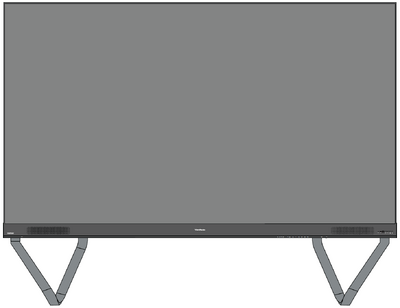


Detachable System Control Box
The System Control Box can be installed under the Cabinets (standard installation) for front access, or behind the Cabinets.
 |
 |
| Standard Installation | Hidden System Control Box Installation |
- NOTE:
- Standard Installation video.
- Follow the below guide to install the display with the Hidden System Control Box layout.
Wall Mounting
Installing the Upper and Lower Wall Mount Brackets

- Ensure the wall area and size is an appropriate installation site.
- NOTE: The height of the Upper Wall Mount Brackets must not be less than 102 ²³/₆₄" (2600 mm) from the ground.
- Using the Wall Mount Bracket (pictured above) as a guide, mark at least eight (8) holes and pre-drill them.
- Install the first Upper Wall Mount Bracket with the provided screws (M6x50mm Expansion for masonry; TA6x30mm for load bearing wood).
- Repeat Step 2, ensuring the second Upper Wall Mount Bracket is level with the first upper bracket. Keep a 3 ¹¹/₃₂" (85 mm) space between the two brackets.
- Install the Lower Wall Mount Brackets in the same manner as the Upper Wall Mount Brackets. The distance between the Upper and Lower Wall Mount Brackets is 66 ²⁷/₆₄" (1687.25 mm).
NOTE: You can also install the Upper Wall Mount Brackets, hang the screen, and then install the Lower Wall Mount Brackets for a more precise fit. Ensure the wall can safely support 423.29 lbs. (192 kg). Ensure the deviation of wall surface must be < ¹³/₆₄" (< 5 mm). - After installing both Upper and Lower Wall Mount Brackets, the installation wall should look like:


Installing the Cabinets
- Ensure the Mounting Brackets on the rear of the six (6) Cabinets are positioned at the top and bottom mounting positions as shown below:
- Carefully lift each Cabinet up onto the Upper Wall Mount Brackets starting from the left.
- Ensure the Mounting Brackets sit securely on the Wall Mount Brackets as shown below.
- Push each Locking Bolt and lock each Hook with the hex tool to securely connect each cabinet together. It may be necessary to align the hole with the hex tool in order to engage the Locking Bolt.
- NOTE: There are six (6) Locking Bolts and 12 Hooks between each cabinet.
- Place the remaining Cabinets up onto the Upper Wall Mount Brackets. Install from left to right, ensuring the Mounting Brackets sit securely on the Wall Mount Brackets.
- Repeat Step 4, securing the Cabinets together with each Locking Bolt and Hook.
- NOTE: There are six (6) Locking Bolts and 12 Hooks between each cabinet.
Connecting the System Control Box (Hidden Installation)
- Carefully unfold the System Control Box panel. Ensure the main system control board is on the right.
- NOTE: Use caution as the System Control Box panel is separated into two pieces with wires attached.
- Install the left part of System Control Box using the M6x16mm screws behind the Cabinet.
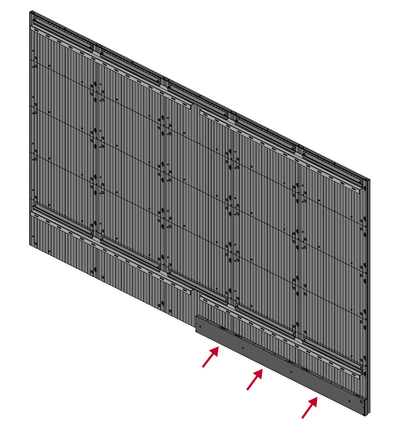
- Install the right part of the System Control Box using the M6x16mm screws behind the Cabinet.
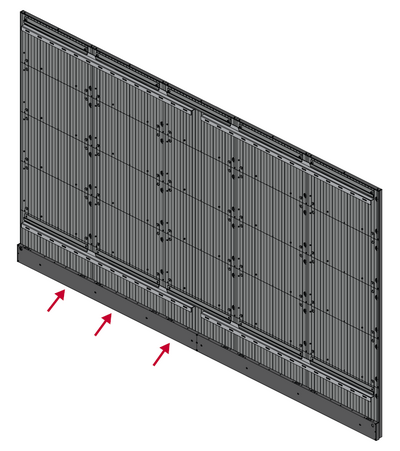
- Connect the Network and Power cables of the Cabinets to the System Control Box.
- NOTE: There are six (6) Network and six (6) Power cables to connect.
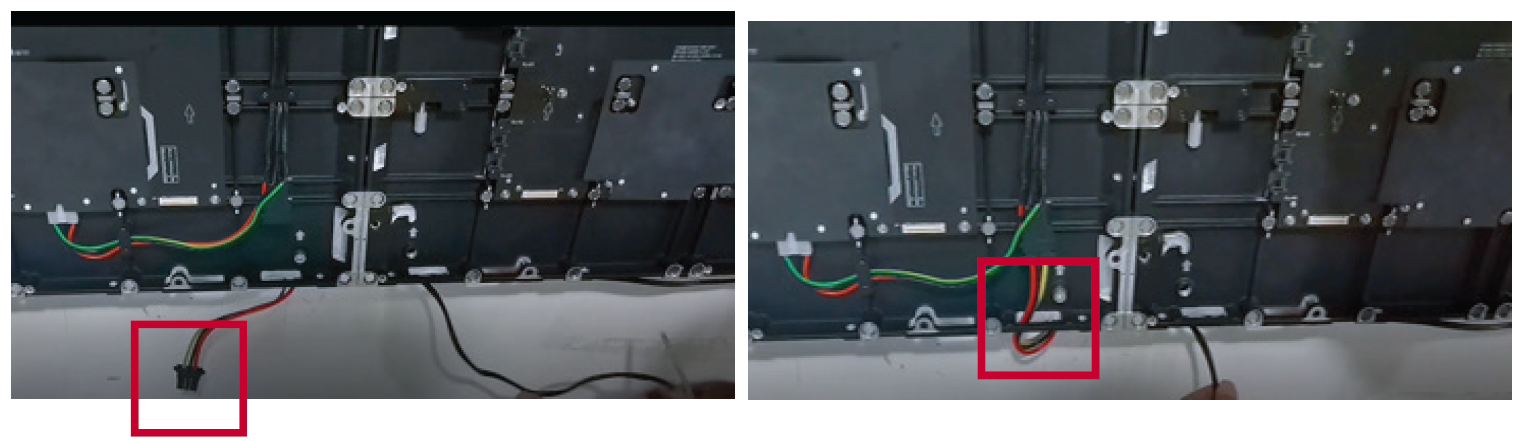
- Route the Power cable through the opening provided in the Cabinet and connect it to the power plug.
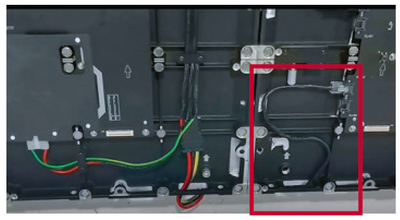
- Route the Network cable through the opening provided in the Cabinet into an “S-shape" and connect it to the network port.
- Install the bezels from the bottom of the screen and use the M6x10mm screws to secure it to the Cabinet.


Installing the LED Modules
|
Please wear Anti-Static Gloves before installing the LED modules. |
- Install each LED Module onto the Cabinets, being sure to match the corresponding numbers on the Module to the Cabinet.
- Ensure each Module is flush and that there is little to no gap between each. It may be necessary to gently tap the module to make it flush.


Dual-Screen Splicing
Two (2) DirectView LED Displays can be installed together to create one (1) large display.
 |
| Standard Installation |
 |
| Hidden System Control Box Installation |
- NOTE: The System Control Boxes can be installed under the Cabinets (standard installation) for front access, or behind the Cabinets.
Wall Mounting
Installing the Upper and Lower Wall Mount Brackets
- Ensure the wall area and size is an appropriate installation site.
- NOTE: The height of the Upper Wall Mount Brackets must not be less than 102 ²³/₆₄" (2600 mm) from the ground.
- Using the Wall Mount Bracket (pictured above) as a guide, mark at least eight (8) holes and pre-drill them.
- Install the first Upper Wall Mount Bracket with the provided screws (M6x50mm Expansion for masonry; TA6x30mm for load bearing wood).
- Repeat Step 2, ensuring the second Upper Wall Mount Bracket is level with the first upper bracket. Keep a 3 ¹¹/₃₂" (85 mm) space between the two brackets.
- Install the Lower Wall Mount Brackets in the same manner as the Upper Wall Mount Brackets. The distance between the Upper and Lower Wall Mount Brackets is 66 ²⁷/₆₄" (1687.25 mm).
NOTE: You can also install the Upper Wall Mount Brackets, hang the screen, and then install the Lower Wall Mount Brackets for a more precise fit. Ensure the wall can safely support 423.29 lbs. (192 kg). Ensure the deviation of wall surface must be < ¹³/₆₄" (< 5 mm). - Repeat Steps 1~5 for the second display. Keep a 5 ³/₈" (136.7 mm) space between the first and second display's Wall Mount Brackets.
- After installing both Upper and Lower Wall Mount Brackets of both displays, the installation wall should look like:

Installing the Cabinets
- Ensure the Mounting Brackets on the rear of the six (6) Cabinets are positioned at the top and bottom mounting positions as shown below:
- Carefully lift each Cabinet up onto the Upper Wall Mount Brackets starting from the left.
- Ensure the Mounting Brackets sit securely on the Wall Mount Brackets as shown below.
- Push each Locking Bolt and lock each Hook with the hex tool to securely connect each cabinet together. It may be necessary to align the hole with the hex tool in order to engage the Locking Bolt.
- NOTE: There are six (6) Locking Bolts and 12 Hooks between each cabinet.
- Place the remaining Cabinets up onto the Upper Wall Mount Brackets. Install from left to right, ensuring the Mounting Brackets sit securely on the Wall Mount Brackets.
- Repeat Step 4, securing the Cabinets together with each Locking Bolt and Hook.
- NOTE: There are six (6) Locking Bolts and 12 Hooks between each cabinet.
- Remove the screws and bezel from Cabinet #6 and Cabinet #7.
- Repeat Steps 1~6 for the second display.
- After installing the Cabinets of both displays, the installation wall should look like:


Connecting the System Control Box (Standard Installation)
- Carefully unfold the System Control Box panel. Ensure the main system control board is on the right.
- NOTE: Use caution as the System Control Box panel will be separated into two pieces, however the wires are connected.
- Align the holes of the Cabinet with the System Control Box to attach.
- You can also reroute the power cable at two positions for cable management. Loosen the two (2) PWM 4x6mm screws, pull the power cable out, thread the power cable through the hole and then fasten the screws tightly.
- Further secure the System Control Box to the Cabinets with the 20 provided screws (M6x10mm).
- Connect the Network and Power cables of the Cabinets to the System Control Box.
- NOTE: There are six (6) Network and six (6) Power cables to connect.
- Repeat Steps 1~5 for the second display.
- After installing the System Control Box of both displays, the installation wall should look like:
- Connect one end of an HDMI cable to the HDMI OUT port of Display 2. Then, connect the other end of the cable to the HDMI IN port of Display 1.
- NOTE: Route the HDMI cable as shown below:
- Install the System Control Box Covers with the KM3x6mm screws from left to right (i.e., Display 1 left cover, Display 1 middle cover, Display 1 right cover, Display 2 left cover, etc.).
- NOTE: See Installing System Control Box Covers for more information.


Connecting the System Control Box (Hidden Installation)
- Connect one end of an HDMI cable to the HDMI OUT port of Display 2. Then, connect the other end of the cable to the HDMI IN port of Display 1.
- NOTE: Route the HDMI cable as shown below:
- Carefully unfold the System Control Box panel. Ensure the main system control board is on the right.
- NOTE: Use caution as the System Control Box panel is separated into two pieces with wires attached.
- Install the left part of System Control Box using the M6x16mm screws behind the Cabinet.
- Install the right part of the System Control Box using the M6x16mm screws behind the Cabinet.
- Connect the Network and Power cables of the Cabinets to the System Control Box.
- NOTE: There are six (6) Network and six (6) Power cables to connect.
- Route the Power cable through the opening provided in the Cabinet and connect it to the power plug.
- Route the Network cable through the opening provided in the Cabinet into an “S-shape" and connect it to the network port.
- Repeat Steps 1~4 for the second display.
- Install the bezels from the bottom of the screen and use the M6x10mm screws to secure it to the Cabinet.
Installing the LED Modules
Install each LED Module onto the Cabinets, being sure to match the corresponding numbers on the Module to the Cabinet.
|
Please wear Anti-Static Gloves before installing the LED modules. |
- Starting with Display 1, install each LED Module onto the Cabinets, being sure to match the corresponding numbers on the Module to the Cabinet.
- Ensure each Module is flush and that there is little to no gap between each. It may be necessary to gently tap the module to make it flush.
- Once Display 1 is complete, repeat Steps 1~2 for Display 2.
- After installing the LED Modules of both displays, the installation wall should look like:
 |
| Standard Installation |
 |
| Hidden System Control Box Installation |
Connecting to External Devices
HDMI IN Connection
Media Player Connection
Connect an HDMI cable from your external device to an HDMI IN port on the LED display.

PC Connection
Connect an HDMI cable from your PC to an HDMI IN port on the LED display.

Audio Connection
Connect an audio cable from your external audio device to the Audio Out port on the LED display.

HDbaseT Connection
Connect a CAT5e/6 cable from your external device to the HDbaseT device before installing the System Control Box Cover.

Video Output Connection
To output video via an external display device, connect an HDMI cable to the HDMI IN port of your external display device, and the other end to the HDMI OUT port of your LED display.

USB and Networking Connections
Just like any PC, it is easy to connect various USB devices and other peripherals to your LED display.
USB (Type A/Type C)
- USB Type A
- Plug the USB device, cable, or storage drive into the USB Type A port.

- USB Type C
- Plug the USB device, cable, or storage drive into the USB Type C port.

Networking and Modem Cables
Plug the network cable into the LAN port.

RS-232 Connection
When you use a RS-232 serial cable to connect your LED display to an external computer and control system certain functions can be controlled remotely such as: Power On/Off, Volume adjustment, Input select, Brightness, and more.

Power On/Off your LED Display

- Ensure the power cord is connected and plugged into a power outlet.
- Press the Power Switch to the ON position.
- Press the Power button to turn on the LED display.
- To turn the LED display off, press the Power button again.
Home Screen

| Number | Item | Description |
|---|---|---|
| 1 | Main Menu | Access the Home Screen, APP Center, Settings, and Input Source. |
| 2 | Time of Day Indicator | The sky will change over the day between morning, noon, afternoon, and night. |
| 3 | Quick Access | Quick access to LAN, Wi-Fi, Brightness, and Power.
|
| 4 | Date & Time | Automatic time adjustment, time zone selection, and 24-hour format can all be adjusted. The Date & Time can also be hidden from the Home Screen under: Settings > Display > Launcher Settings |
| 5 | ViewSonic Logo | The logo can be hidden from the Home Screen under: Settings > Display > Launcher Settings |
Remote Control
The remote control can be used to easily navigate the Home Screen. When using the remote control, ensure it is kept within the IR receiver range as shown below:
Keyboard and Mouse
When connected to the USB Type-A port of the display, a keyboard and mouse can also be used to navigate the Home Screen.
The mouse pointer will appear as an orange dot on the display when used:

- The left mouse button will confirm actions.
- The right mouse button will go back to the previous layer.
- Keyboard shortcuts and hot keys are also supported, including: audio adjustment, mute, and back to the Home Screen.
APP Center

| Icon | Name | Description |
|---|---|---|
 |
Browser | Web browser |
 |
Display | Wirelessly mirror your desktop |
 |
EAirplay | AirPlay mirroring |
 |
EnterpriseAgent | Device management |
 |
File Manager | File explorer |
 |
Manager | Remote device management |
 |
Revel Digital Signage | Manage digital signage |
 |
Settings | View and adjust the display’s settings |
 |
SureMDM Nix | Secure, monitor, and manage devices |
 |
WPS Office | Create documents, spreadsheets, and presentations |
 |
vCastReceiver | Receive casted content from devices |
 |
vSweeper | Clear up storage space |
- NOTE: Preloaded applications are subject to change without notice.
Input Source

The display supports eight input sources: Home, HDMI 1,HDMI 2, HDMI 3, HDMI 4, HDMI 5, HDBaseT, and USB C.
Settings
Adjust and view the display's settings.


| Menu | Description |
|---|---|
| Network & Internet | View and adjust Wi-Fi, Ethernet, and Potable Hotspot. |
| Connected Devices | View and adjust Connected Devices. |
| Apps | View and adjust App Info., App Permissions, and Default Apps. |
| Display | View and adjust Brightness Level, Ambient Light Sensor, Font Size, Startup & Shutdown, Input Setting, and Launcher Settings. |
| Sound | View and adjust Media Volume. |
| Storage | View and adjust Device Storage. |
| System | View and adjust Languages & Input, Date & Time, Dehumidification, Reset, and About Device. |
| Upgrade | View and adjust OTA Upgrade and Local Update. |
Settings Menu Tree
Network & Internet
| Sub-menu | Menu Option | ||
|---|---|---|---|
| Wi-Fi | Wi-Fi | On | |
| Off | |||
| Wi-Fi List | Add Network | ||
| Wi-Fi Preference | Open Network Notification | On | |
| Off | |||
| Keep Wi-Fi On During Sleep | |||
| Advanced | |||
| Ethernet | Ethernet IP Mode | DHCP | |
| STATIC | |||
| Ethernet Details | |||
| Portable Hotspot | Portable Wi-Fi Hotspot | On | |
| Off | |||
Connected Devices
| Sub-menu | Menu Option |
|---|---|
| Connected Devices | On |
| Off | |
| Device Name | ViewSonic DvLED |
Apps
| Sub-menu | Menu Option | |
|---|---|---|
| App Info. | Installed Apps | Disable |
| Force Stop | ||
| App Permissions | Calendar | |
| Location | ||
| Microphone | ||
| Storage | ||
| Default Apps | Browser | |
| Home | ||
Display
| Sub-menu | Menu Option | ||
|---|---|---|---|
| Brightness Level | (-/+, 1~8) | ||
| Ambient Light Sensor | On | ||
| Off | |||
| Font Size | (-/+, 1~4) | ||
| Dual-Screen Splicing | Enable | On | |
| Off | |||
| Startup & Shutdown | Splash Screen | Default | |
| ViewSonic | |||
| Black | |||
| Blue | |||
| Last Shutdown Channel | On | ||
| Off | |||
| Default Startup Channel | Home | ||
| HDMI 1 | |||
| HDMI 2 | |||
| HDMI 3 | |||
| HDMI 4 | |||
| HDMI 5 | |||
| USB C | |||
| HDBaseT | |||
| APP (Display) | |||
| APP (vCastReceiver) | |||
| Standby Mode | Hibernate | ||
| Sleep | |||
| Splash Screen | ViewSonic | ||
| Black | |||
| Blue | |||
| Input Setting | Input Alias | HDMI 1 | Display |
| Hide | |||
| HDMI 2 | Display | ||
| Hide | |||
| HDMI 3 | Display | ||
| Hide | |||
| HDMI 4 | Display | ||
| Hide | |||
| HDMI 5 | Display | ||
| Hide | |||
| USB C | Display | ||
| Hide | |||
| HDBaseT | Display | ||
| Hide | |||
| Signal Source Detect | Enable | ||
| Disable | |||
| Launcher Settings | ViewSonic Logo | On | |
| Off | |||
| Date & Time | On | ||
| Off | |||
| Theme | |||
| Other Display Settings | Custom Resolution | Width | |
| Height | |||
| Custom DPI | (-/+, 100~200) | ||
| Custom Wallpaper | |||
| Boot Logo Settings | |||
Sound
| Sub-menu | Menu Option | ||
|---|---|---|---|
| Media Volume | (-/+, 0~100) | ||
Storage
| Sub-menu | Menu Option | ||
|---|---|---|---|
| Device Storage | Internal Shared Storage | Storage Manager | On |
| Off | |||
| Photos & Videos | |||
| Music & Audio | |||
| Games | |||
| Movie & TV | |||
System
| Sub-menu | Menu Option | ||
|---|---|---|---|
| Language & Input | Languages | English | |
| French | |||
| Spanish | |||
| German | |||
| Russian | |||
| Dutch | |||
| 繁体中文 | |||
| 简体中文 | |||
| Turkish | |||
| Arabic | |||
| Virtual Keyboard | Remote Control Input Method | ||
| Manage Keyboards | |||
| Timer Setting | Shutdown Time | Repeat | Off |
| Once | |||
| Everyday | |||
| Time | |||
| Power On Time | Repeat | Off | |
| Once | |||
| Everyday | |||
| Time | |||
| Sleep Timer | Off/1/10/20/30/40/50/60/90/120 minute(s) | ||
| Power Saving | On | ||
| Off | |||
| Standby Mode | Hibernate | ||
| Sleep | |||
| Date & Time | Automatic Date & Time | On | |
| Off | |||
| Select Time Zone | |||
| Use 24-hour Format | |||
| Dehumidification | Settings | On | |
| Off | |||
| Automatic Reminders | On | ||
| Off | |||
| Begin Dehumidification Now | On | ||
| Off | |||
| Scheduled | On | ||
| Off | |||
| Reset | Network Settings Reset | ||
| Reset App Preferences | |||
| Factory Data Reset | |||
| About Device | Status | ||
| Legal Information | |||
| Model | |||
| Kernel Version | |||
| Build Number | |||
| Total Time | |||
Upgrade
| Sub-menu | Menu Option |
|---|---|
| OTA Upgrade | OTA Cloud Server |
| Local Update | sda1 |
| SDcard |
Network & Internet

| Sub-menu | Description |
|---|---|
| Wi-Fi |
|
| Ethernet | Select Ethernet to enable/disable Ethernet, review DNS, and IP mode. |
| Portable Hotspot | Enable/disable Portable Wi-Fi Hotspot under Portable Hotspot. |
Connected Devices

Enable/disable device connection, review connected devices, and search and connect to other devices.
Apps

| Sub-menu | Description |
|---|---|
| App Info. |
|
| App Permissions | Select App Permissions to manage various application permissions. |
| Default Apps | Select your default applications. |
Display

| Sub-menu | Description |
|---|---|
| Brightness Level | Adjust the brightness level by eight (8) levels. |
| Ambient Light Sensor | Detects ambient light and adjusts brightness levels automatically. |
| Font Size | Preview and adjust the font size on the display. |
| Dual-Screen Splicing | Enable Dual-Screen Splicing if installing two (2) DirectView LED Displays together. |
| Startup & Shutdown |
Startup Channel
Standby Mode
Splash Screen |
| Input Setting |
Input Alias Switch |
| Launcher Settings |
ViewSonic Logo |
| Other Display Settings | Adjust the Resolution, DPI, wallpaper and other display settings. |
Sound

| Sub-menu | Description |
|---|---|
| Media Volume | Adjust the volume level of the display. |
Storage

| Sub-menu | Description |
|---|---|
| Internal Shared Storage | Internal storage allocation. |
System

| Sub-menu | Description |
|---|---|
| Languages & Input |
Languages |
| Timer Setting |
Shutdown Time Repeat |
| Date & Time |
Automatic Date & Time |
| Dehumidification | Start and adjust dehumidification settings. |
| Reset |
Network Settings Reset |
| About Device | View information about the display. |
Upgrade

| Sub-menu | Description |
|---|---|
| OTA Upgrade |
Auto Update
|
On-Screen Display (OSD) Menu Operation
Use the On-Screen Display (OSD) Menu to adjust various settings.

To open and operate the OSD Menu:
- Press the MENU button on the remote control.
- Press ▼/▲/◄/► on the remote control to select menu items or adjust values.
- Press OK to confirm your selection.
- Press the RETURN button to go back to the previous menu level.
- Press the MENU button to exit the OSD Menu.
On-Screen Display (OSD) Menu Tree
Color Mode
| Sub-menu |
|---|
| User |
| TV |
| Movie |
| Presentation |
Display Mode
| Sub-menu | Menu Option |
|---|---|
| Aspect Ratio | Auto |
| 4:3 | |
| 16:9 | |
| Native | |
| Brightness | (-/+, 0~100) |
| Contrast | (-/+, 0~100) |
| Tint | (-/+, -50~50) |
| Saturation | (-/+, 0~100) |
| Sharpness | (-/+, 0~20) |
| Gamma | Dark |
| Middle | |
| Bright | |
| Color Temp | User |
| Standard | |
| Cool | |
| Warm | |
| Reset |
Advanced Mode
| Sub-menu | Menu Option |
|---|---|
| HDR | Auto |
| SDR | |
| EOTF | Dark |
| Middle | |
| Bright | |
| HDMI Setting | Auto |
| Full | |
| Limited |
Speaker
| Sub-menu | Menu Option |
|---|---|
| Audio Mode | User |
| Standard | |
| Vivid | |
| Sports | |
| Movie | |
| Music | |
| News | |
| Auto | |
| EQ_120Hz | (-/+, 0~100) |
| EQ_500Hz | (-/+, 0~100) |
| EQ_1.5KHz | (-/+, 0~100) |
| EQ_10KHz | (-/+, 0~100) |
| Reset | |
| Audio Volume | (-/+, -50~50) |
| Mute | On |
| Off |
PIP/PBP Mode
| Sub-menu | Menu Option |
|---|---|
| Off | |
| PIP | Sub Picture on Top Left |
| Sub Picture on Top Right | |
| Sub Picture on Bottom Left | |
| Sub Picture on Bottom Right | |
| PBP | Windows x 2 |
| Windows x 3 | |
| Windows x 4 |
Information
| Sub-menu |
|---|
| Source |
| Resolution |
| HDR |
On-Screen Display (OSD) Menu Options
Color Mode

- Press MENU on the remote control to display the OSD Menu.
- Then press OK or use ▼/▲/◄/► on the remote control to select the Color Mode menu.
- Press ▼/▲ to select the menu option. Then press OK to display its sub-menu, or press ◄/► to adjust/select the setting.
| Menu Option | Description |
|---|---|
| Color Mode |  Standard User TV Movie Presentation |
Display Mode

- Press MENU on the remote control to display the OSD Menu.
- Then press OK or use ▼/▲/◄/► on the remote control to select the Display Mode menu.
- Press ▼/▲ to select the menu option. Then press OK to display its sub-menu, or press ◄/► to adjust/select the setting.
| Menu Option | Description |
|---|---|
| Aspect Ratio | The Aspect Ratio is the ratio of the image width to the image height.
  Auto 4:3 16:9 Native |
| Brightness | The higher the value, the brighter the image. Lower values will result in a darker image. |
| Contrast | Use this to set the peak white level after you have previously adjusted the Brightness setting to suit your selected input and viewing environment. |
| Tint | The higher the value, the more greenish the picture becomes. The lower the value, the more reddish the picture becomes. |
| Saturation | Refers to the amount of that color in a video picture. Lower settings produce less saturated colors; in fact, a setting of “0” removes that color from the image entirely. If the saturation is too high, that color will be overpowering and unrealistic. |
| Sharpness | A high value results in a sharper picture; a low value softens the picture. |
| Gamma | Manually adjust the brightness level of the monitor’s grayscale levels.  |
| Color Temp | Manually adjust the red, green, and blue values.  |
| Reset | Return the Display Mode settings to their default values.  |
Advanced Mode

- Press MENU on the remote control to display the OSD Menu.
- Then press OK or use ▼/▲/◄/► on the remote control to select the Advanced Mode menu.
- Press ▼/▲ to select the menu option. Then press OK to display its sub-menu, or press ◄/► to adjust/select the setting.
| Menu Option | Description |
|---|---|
| HDR |   SDR Auto |
| EOTF | Automatically adjusts the brightness levels of your image according to the input source. You can also manually select a brightness level to display better picture quality. |
| HDMI Setting |  Auto Full Limited |
Speaker

- Press MENU on the remote control to display the OSD Menu.
- Then press OK or use ▼/▲/◄/► on the remote control to select the Speaker menu.
- Press ▼/▲ to select the menu option. Then press OK to display its sub-menu, or press ◄/► to adjust/select the setting.
| Menu Option | Description |
|---|---|
| Audio Mode |  Music Movie User |
| Reset | Return the Speaker settings to their default values. |
| Audio Volume | Adjust the volume level. |
| Mute | Toggle ON to turn off the speaker. |
PIP/PBP Mode

- Press MENU on the remote control to display the OSD Menu.
- Then press OK or use ▼/▲/◄/► on the remote control to select the PIP/PBP Mode menu.
- Press ▼/▲ to select the menu option. Then press OK to display its sub-men.
| Menu Option | Description |
|---|---|
| PIP/PBP Setup |  Off PIP    PBP   |
Information

- Press MENU on the remote control to display the OSD Menu.
- Then press OK or use ▼/▲/◄/► on the remote control to select the Information menu.
- Press ▼/▲ to select the menu option. Then press OK to display its sub-menu, or press ◄/► to adjust/select the setting.
| Menu Option | Description |
|---|---|
| Information | View Input Source, Resolution, and HDR information.
 |
vCast
Working with ViewBoard® Cast software (vCast, vCast Pro, and vCastSender), the vCast application will allow the ViewBoard to receive laptop screens (Windows/Mac/Chrome) and mobile (iOS/Android) users’ screens, photos, videos, annotations, and camera(s) that are using the vCastSender application.

- NOTE:
- ViewBoard® Cast software, laptops, and mobile devices can connect to both the same subnet and cross subnet by entering the on-screen PIN code.
- Connected devices will show up under Device List on the same subnet connection.
- If the device does not show up under Device List, users will need to key-in the on-screen PIN code.
Network Information
- Ports:
- TCP 56789, 25123, 8121 & 8000 (Controlling message port & client device audio transfer)
- TCP 8600 (BYOM)
- TCP 53000 (Request share screen)
- TCP 52020 (Reverse control)
- TCP 52025 (Reverse control for ViewBoard Cast Button)
- TCP 52030 (Status sync)
- UDP 48689, 25123 (Device searching and broadcast & client device audio transfer)
- UDP 5353 (Multicast search device protocol)
- Port and DNS Activation:
- Port: 443
- DNS: https://vcastactivate.viewsonic.com
- OTA Service:
- Server Port: TCP443
- Server FQDN Name: https://vcastupdate.viewsonic.com
Casting from Windows, MacBook, and Chrome Devices

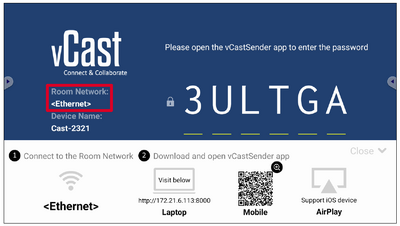
- Ensure the client device (e.g., laptop) is connected to the same network as the ViewBoard.
- NOTE: The network name can be found under Room Network.
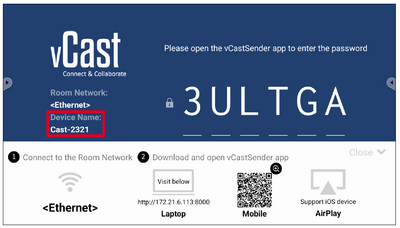
- On the client device, visit the address that is shown on the ViewBoard to download and install the vCastSender application.
- After installing, launch the vCastSender application.
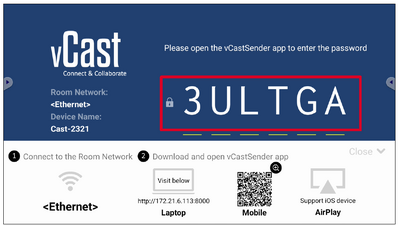
- To connect to the ViewBoard, input the PIN code and click OK.
- NOTE: The PIN code can be found as highlighted below:
- Additionally, you can connect to the ViewBoard or display by clicking Device List then the Device Name listed.
- NOTE: The Device Name can be found as highlighted below:


Casting from Android Devices

- Ensure the client device (e.g., Android phone or tablet) is connected to the same network as the ViewBoard.
- NOTE: The network name can be found under Room Network.
- On the Android client device, scan the QR code shown on the ViewBoard to directly download the vCastSender application, or download the application from the Google Play Store.
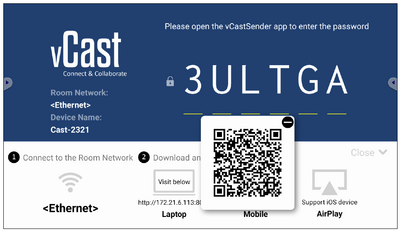
- After installing, launch the vCastSender application.
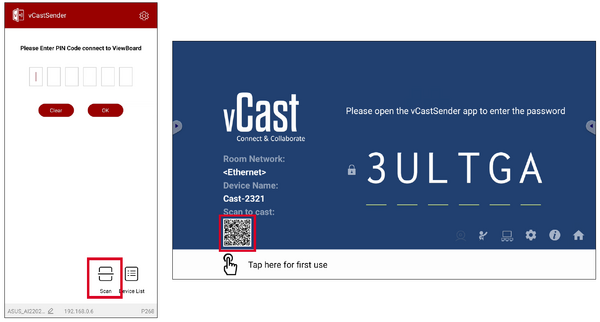
- To connect to the display, input the PIN code and select OK.
- NOTE: The PIN code can be found as highlighted below:
- You can also connect to the ViewBoard by clicking Device List then the Device Name listed.
- NOTE: The Device Name can be found as highlighted below:
- Additionally, you can connect to the ViewBoard by selecting Scan then placing the on-screen QR code into the box to automatically connect.


Casting from Apple iOS Devices
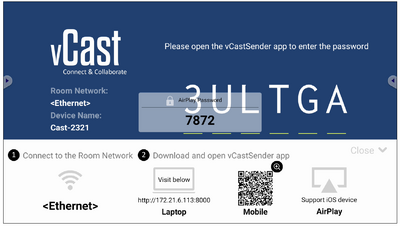
Apple AirPlay® is compatible with vCast for screen mirroring and content streaming under the same subnet environment only. An “AirPlay Password” will be generated on-screen for connection when using AirPlay to cast to a ViewBoard.

- Ensure the client device (e.g., iPhone or iPad) is connected to the same network as the ViewBoard.
- NOTE: The network name can be found under Room Network.
- On the iOS client device, directly open AirPlay and select the Device Name of the ViewBoard to connect.
- NOTE: The Device Name can be found as highlighted below:
- Input the generated on-screen AirPlay Password on the client device to connect.
- NOTE: In a cross subnet environment, please download and connect with the vCastSender iOS application from the Apple App Store.
- You can also connect to the ViewBoard by selecting Scan then placing the on-screen QR code into the box to automatically connect.

vSweeper
Clear unnecessary data and unwanted files.

Advanced Settings can also be customized to the user's needs.

Browser
Web browser for surfing the internet.

WPS Office
Create, edit, and view Documents, Memos, Presentations, and Spreadsheets.

RS-232
This document describes the hardware interface and software protocols of RS-232 serial communication between the ViewSonic LED Display and computers or control systems.
RS-232 Hardware Specification
ViewSonic RSD-232 serial port on the lower left side:
- Connector type: DB 9-Pin Female
- Use of straight-through parallel cable for connection
- Pin Assignment:
| Pin # | Signal | Remark | |
|---|---|---|---|
| Female DB 9-Pin | 1 | NC | |

|
2 | TXD | Output from Display |
| 3 | RXD | Input to Display | |
| 4 | NC | ||
| 5 | GND | GND | |
| 6 | NC | ||
| 7 | NC | ||
| 8 | NC | ||
| 9 | NC | ||
| frame | GND |
RS-232 Communication Setting
| Baud Rate Select: | 115200bps (fixed) |
| Data Bits: | 8 bits (fixed) |
| Parity: | None (fixed) |
| Stop Bits: | 1 (fixed) |
Command Table
| Function | Command Code (Hex) | HEX | Data Range |
|---|---|---|---|
| Power On | 21 | 38 30 31 73 21 30 30 31 0D | |
| Power Off (Standby) | 21 | 38 30 31 73 21 30 30 30 0D | |
| Get-Power Status | 6C | 38 30 31 67 6C 30 30 30 0D | |
| Input Select: HDMI 1 | 22 | 38 30 31 73 22 30 30 34 0D | |
| Input Select: HDMI 2 | 22 | 38 30 31 73 22 30 31 34 0D | |
| Get-Input Select | 6A | 38 30 31 67 6A 30 30 30 0D | |
| Input Select: Home | 22 | 38 30 31 73 22 30 30 41 0D | |
| Brightness: Down (-1) | 24 | 38 30 31 73 24 39 30 30 0D | |
| Brightness: Up (+1) | 24 | 38 30 31 73 24 39 30 31 0D | |
| Volume: Down (-1) | 35 | 38 30 31 73 35 39 30 30 0D | |
| Volume: Up (+1) | 35 | 38 30 31 73 35 39 30 31 0D | |
| Get-Volume | 66 | 38 30 31 67 66 30 30 30 0D | |
| Mute: OFF | 36 | 38 30 31 73 36 30 30 30 0D | |
| Mute: ON (mute) | 36 | 38 30 31 73 36 30 30 31 0D | |
| Get-Mute | 67 | 38 30 31 67 67 30 30 30 0D | |
| Number (0~9) | 40 | 38 30 31 73 40 30 30 3x 0D | x = 0~9 |
| Key Pad: UP | 41 | 38 30 31 73 41 30 30 30 0D | |
| Key Pad: DOWN | 41 | 38 30 31 73 41 30 30 31 0D | |
| Key Pad: LEFT | 41 | 38 30 31 73 41 30 30 32 0D | |
| Key Pad: RIGHT | 41 | 38 30 31 73 41 30 30 33 0D | |
| Key Pad: ENTER | 41 | 38 30 31 73 41 30 30 34 0D | |
| Key Pad: INPUT | 41 | 38 30 31 73 41 30 30 35 0D | |
| Key Pad: MENU | 41 | 38 30 31 73 41 30 30 36 0D | |
| Key Pad: EXIT | 41 | 38 30 31 73 41 30 30 37 0D | |
| Get-Operational Hours | 31 | 38 30 31 67 31 30 30 30 0D |
Technical Specifications
| Item | Category | Specifications | |||
|---|---|---|---|---|---|
| Model No. | VS18885 | ||||
| P/N | LDP163-181 | ||||
| LED Screen | Type | Direct View LED Display | |||
| Size | 163" | ||||
| Active Size | 141.73” (H) x 79.72” (V)
3,600 mm (H) x 2,025 mm(V) | ||||
| Pitch Size | 1.875 mm | ||||
| Resolution | FHD, 1920 x 1080 | ||||
| Refresh Frequency | 4440Hz | ||||
| Contrast Ratio | 6000:1 (Typical) | ||||
| Brightness | 100-600 cd/m2 (8 levels of adjustments) | ||||
| LED Lifespan | 100,000 hours | ||||
| Input Signal | 5 x HDMI (1920 x 1080 @ 60Hz, HDCP 2.2)
1 x LAN (RJ45) 3 x USB Type A (2.0) 1 x USB Type C | ||||
| Output Signal | 2 x HDMI (1080p @ 60Hz)
1 x Audio Out (3.5 mm) 3 x USB Type A (Power)[5V/1.5A] | ||||
| Speaker Output | 20W x 2 Harman-Kardon | ||||
| RS-232 | RS-232 Serial Control | ||||
| Power | Voltage | 100V-120V/30A ~ 50/60Hz 220-240V/15A ~ 50Hz (vary by country) | |||
| Operating Conditions | Temperature | 32° F to 104° F (0° C to 40° C) | |||
| Humidity | 20%~80% non-condensing | ||||
| Altitude | ≤ 6,562 ft (2,000 m) | ||||
| Storage Conditions | Temperature | -4° F to 140° F (-20° C to 60° C) | |||
| Humidity | 10%~90% non-condensing | ||||
| Altitude | ≤ 6,562 ft (2,000 m) | ||||
| Physical Dimensions (W x H x D) |
w/o Wall Mount | 142.13” x 84.45” x 0.98”
(3,610 x 2,145 x 25 mm) | |||
| w/ Wall Mount | 142.13” x 84.45” x 2.24”
(3,610 x 2,145 x 57 mm) | ||||
| Weight | Physical | 375 lbs. (170 kg) | |||
| Power Consumption | On | 1,400W (Normal)
2,200W (Max) | |||
| Sleep | < 0.5W | ||||
| Off | < 0W | ||||
- NOTE: Product specifications are subject to change without notice.
LED Display Stuck Pixel Definition

| Item | Acceptance Criteria |
|---|---|
| Stuck Pixel (whole display) |
≤ 60 stuck pixels |
| Stuck Pixel (as marked in green) |
≤ 18 stuck pixels |
| Stuck Pixel (Single Module) |
≤ 6 stuck pixels |
Timing Chart
HDMI (PC)
| Resolution | Refresh Rate (Hz) |
|---|---|
| 640 x 480 | 60, 72, 75 |
| 720 x 400 | 70, 85 |
| 800 x 600 | 56, 60, 72, 75 |
| 832 x 624 | 75 |
| 1024 x 768 | 60, 70, 75 |
| 1152 x 864 | 60, 70, 75 |
| 1152 x 870 | 75 |
| 1280 x 720 | 60 |
| 1280 x 960 | 60 |
| 1280 x 1024 | 60, 75 |
| 1360 x 768 | 85 |
| 1440 x 900 | 60 |
| 1600 x 1200 | 60, 70, 75 |
| 1680 x 1050 | 60 |
| 1920 x 1080 | 60 |
| 1920 x 1200 | 60 |
| 3840 x 2160 | 30, 60 |
HDMI (Video)
| Video | Resolution | Refresh Rate (Hz) |
|---|---|---|
| 480i | 720 x 480 | 60 |
| 1440 x 480 | 60 | |
| 576i | 720 x 576 | 50 |
| 1440 x 576 | 50 | |
| 480p | 720 x 480 | 60 |
| 576p | 720 x 576 | 50 |
| 1440 x 576 | 50 | |
| 720p | 1280 x 720 | 60 |
| 1080i | 1920 x 1080 | 50, 60 |
| 1080p | 1920 x 1080 | 24, 25, 30, 50, 60 |
| 2160p | 3840 x 2160 | 30, 60 |
- NOTE:
- The computer text quality is optimal in HD 1080 mode (1920 x 1080, 60Hz).
- Your computer display screen might appear different depending on the manufacturer and your operating system.
- Consult your computer’s instructional manual on how to connect to an external display.
- If a vertical and horizontal frequency-select mode exists, select 60Hz (vertical) and 67.5KHz(horizontal). In some cases, abnormal signals (such as stripes) might appear on the screen when the computer power is turned off (or if the computer is disconnected). If this is the case, press the [INPUT SOURCE] button to enter the video mode and supply an active signal.
- The display timings conform to VESA and CTA standards.
- For 4:3 content, the screen will display them in the center of the screen and maintain a 4:3 aspect ratio.
- The optimal vertical frequency for each mode is 60Hz.
Supported Media Formats
Multimedia Codec Formats
| Type | File Type | Codec | Ability |
|---|---|---|---|
| Photo | PNG | Max Resolution: 8000 × 8000 Min Resolution : 4 x 4 | |
| JPEG/JPG | Max Resolution: 8000 × 8000 Min Resolution: 4 x 4 | ||
| Video | .3gp | H.263 | Max Resolution: 1920 x 1080 30 Audio: AMR_NB |
| MPEG-4 | Max Resolution: 1920 x 1080 30 Audio: AMR_NB | ||
| .avi | MPEG-2/4 | Max Resolution: 1920 x 1080 30 Audio: MPEG_Audio_Layer3 | |
| MJPEG | Max Resolution: 1920 x 1080 30 Audio: MPEG_Audio_Layer3 | ||
| .flv | H.264 | Max Resolution: 1920 x 1080 30 Audio: AAC 2.0 | |
| .mkv | H.264 | Max Resolution: 1920 x 1080 30 Audio: AAC 2.0 | |
| H.265 | Max Resolution: 1920 x 1080 30 Audio: AAC 2.0 | ||
| .mp4 | H.264 | Max Resolution: 3840 x 2160 30 Audio: MPEG_Audio_Layer3 | |
| H.265 | Max Resolution: 3840 x 2160 30 Audio: MPEG_Audio_Layer3 | ||
| MPEG-4 | Max Resolution: 1920 x 1080 30 Audio: MPEG_Audio_Layer3 | ||
| .vob | MPEG-2 | Max Resolution: 1920 x 1080 30 Audio: PCM | |
| .mpg/.mpeg | MPEG-2 | Max Resolution: 1920 x 1080 30 Audio: MPEG_Audio_Layer3 | |
| Audio | .aac | GAAC | Sample Rate: 8K~96KHz Bit Rate: 24K~576Kbps |
| .ape | Monkey's Audio | Sample Rate: max 48KHz Bit Rate: max 1411Kbps | |
| .flac | FLAC | Sample Rate: max 192KHz Bit Rate: max 1411Kbps | |
| .m4a | ALAC | Sample Rate: 8K~96KHz Bit Rate: 24K~576Kbps | |
| .mp3 | MPEG1/2 layer 3 | Sample Rate: 8K~48KHz Bit Rate: 32K~320Kbps | |
| .ogg | Vorbis | Sample Rate: 8K~48KHz Bit Rate: max 256Kbps | |
| .wav | LPCM | Sample Rate: 8K~192KHz Bit Rate: max 320Kbps |
Compliance Information
This section addresses all connected requirements and statements regarding regulations. Confirmed corresponding applications shall refer to nameplate labels and relevant markings on the unit.
FCC Compliance Statement
This device complies with part 15 of FCC Rules. Operation is subject to the following two conditions: (1) this device may not cause harmful interference, and (2) this device must accept any interference received, including interference that may cause undesired operation. This equipment has been tested and found to comply with the limits for a Class B digital device, pursuant to part 15 of the FCC Rules.
These limits are designed to provide reasonable protection against harmful interference in a residential installation. This equipment generates, uses, and can radiate radio frequency energy, and if not installed and used in accordance with the instructions, may cause harmful interference to radio communications. However, there is no guarantee that interference will not occur in a particular installation. If this equipment does cause harmful interference to radio or television reception, which can be determined by turning the equipment off and on, the user is encouraged to try to correct the interference by one or more of the following measures:
- Reorient or relocate the receiving antenna.
- Increase the separation between the equipment and receiver.
- Connect the equipment into an outlet on a circuit different from that to which the receiver is connected.
- Consult the dealer or an experienced radio/TV technician for help.
The antenna(s) used for this transmitter must not be collocated or operating in conjunction with any other antenna or transmitter.
The device was tested and complies to measurement standards and procedures specified in FCC CFR Tile 47 Part 15 Subpart C.
FCC Radiation Exposure Statement
This equipment complies with FCC radiation exposure limits set forth for an uncontrolled environment. End users must follow the specific operating instructions for satisfying RF exposure compliance.
This transmitter must not be co-located or operating in conjunction with any other antenna or transmitter. This equipment should be installed and operated with a minimum distance of 20 centimeters between the radiator and your body.
The users manual or instruction manual for an intentional or unintentional radiator shall caution the user that changes or modifications not expressly approved by the party responsible for compliance could void the user’s authority to operate the equipment.
IC Warning Statement
This device complies with Industry Canada license- exempt RSS standard(s). Operation is subject to the following two conditions: (1) this device may not cause interference, and (2) this device must accept any interference, including interference that may cause undesired operation of the device.
Le présent appareil est conforme aux CNR d’Industrie Canada applicables aux appareils radio exempts de licence. L’exploitation est autorisée aux deux conditions suivantes : ( 1 ) l’appareil ne doit pas produire de brouillage, et ( 2) l’utilisateur de l’appareil doit accepter tout brouillage radioélectrique subi, méme si le brouillage est susceptible d’en compromettre le fonctionnement.
Country Code Statement
For product available in the USA/Canada market, only channel 1~11 can be operated. Selection of other channels is not possible.
Pour les produits disponibles aux États-Unis/Canada du marché, seul le canal 1 à 11 peuvent être exploités. Sélection d’autres canaux n’est pas possible.
IC Radiation Exposure Statement
This equipment complied with IC RSS-102 radiation exposure limits set forth for an uncontrolled environment. This equipment should be installed and operated with minimum distance 20cm between the radiator & your body. The device for the band 5150-5825 MHz is only for indoor usage to reduce potential for harmful interference to co-channel mobile satellite systems.
Cet équipement est conforme aux limites d’exposition aux rayonnements IC établies pour un environnement non contrôlê. Cet équipement doit être installé et utilize avec un minimum de 20cm de distance entre la source de rayonnement et votre corps. les dispositifs fonctionnant dans la bande 5150-5825 MHz sont réservés uniquement pour une utilisation à l’intérieur afin de réduire les risques de brouillage préjudiciable aux systèmes de satellites mobiles utilisant les mêmes canaux.
CE Conformity for European Countries
 |
The device complies with the EMC Directive 2014/30/EU and Low Voltage Directive 2014/35/EU. |
The following information is only for EU-member states
| The mark shown to the right is in compliance with the Waste Electrical and Electronic Equipment Directive 2012/19/EU (WEEE). The mark indicates the requirement NOT to dispose of the equipment as unsorted municipal waste, but use the return and collection systems according to local law. | 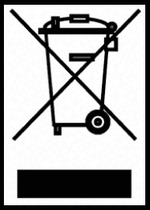 |
Declaration of RoHS2 Compliance
This product has been designed and manufactured in compliance with Directive 2011/65/EU of the European Parliament and the Council on restriction of the use of certain hazardous substances in electrical and electronic equipment (RoHS2 Directive) and is deemed to comply with the maximum concentration values issued by the European Technical Adaptation Committee (TAC) as shown below.
| Substance | Proposed Maximum Concentration | Actual Concentration |
|---|---|---|
| Lead (Pb) | 0.1% | < 0.1% |
| Mercury (Hg) | 0.1% | < 0.1% |
| Cadmium (Cd) | 0.01% | < 0.01% |
| Hexavalent Chromium (Cr6⁺) | 0.1% | < 0.1% |
| Polybrominated biphenyls (PBB) | 0.1% | < 0.1% |
| Polybrominated diphenyl ethers (PBDE) | 0.1% | < 0.1% |
| Bis (2-ethylhexyl) phthalate (DEHP) | 0.1% | < 0.1% |
| Butyl benzyl phthalate (BBP) | 0.1% | < 0.1% |
| Dibutyl phthalate (DBP) | 0.1% | < 0.1% |
| Diisobutyl phthalate (DIBP) | 0.1% | < 0.1% |
Certain components of products as stated above are exempted under the Annex III of the RoHS2 Directives as noted below. Examples of exempted components are:
- Copper alloy containing up to 4% lead by weight.
- Lead in high melting temperature type solders (i.e. lead-based alloys containing 85% by weight or more lead).
- Electrical and electronic components containing lead in a glass or ceramic other than dielectric ceramic in capacitors, e.g. piezoelectronic devices, or in a glass or ceramic matrix compound.
- Lead in dielectric ceramic in capacitors for a rated voltage of 125 V AC or 250 V DC or higher.
European Union Regulatory Conformance
The equipment complies with the RF Exposure Requirement 2014/53/EU, Council Recommendation of 16 April 2014 on the limitation of exposure of the general public to electromagnetic fields (0-300 GHz). This equipment meets the following conformance standards: EN301489-1, EN301489-17, EN62368-1, EN300328.
We, hereby, declare that this Wi-Fi radio is in compliance with the essential requirements and other relevant provisions of Directive 2014/53/EU.
Indian Restriction of Hazardous Substances
Restriction on Hazardous Substances statement (India). This product complies with the “India E-waste Rule 2011” and prohibits use of lead, mercury, hexavalent chromium, polybrominated biphenyls or polybrominated diphenyl ethers in concentrations exceeding 0.1 weight % and 0.01 weight % for cadmium, except for the exemptions set in Schedule 2 of the Rule.
Indian Restriction of Hazardous Substances
Restriction on Hazardous Substances statement (India). This product complies with the “India E-waste Rule 2011” and prohibits use of lead, mercury, hexavalent chromium, polybrominated biphenyls or polybrominated diphenyl ethers in concentrations exceeding 0.1 weight % and 0.01 weight % for cadmium, except for the exemptions set in Schedule 2 of the Rule.
Product Disposal at End of Product Life
ViewSonic® respects the environment and is committed to working and living green. Thank you for being part of Smarter, Greener Computing. Please visit the ViewSonic® website to learn more.
USA & Canada:
https://www.viewsonic.com/us/go-green-with-viewsonic
Europe:
https://www.viewsonic.com/eu/environmental-social-governance/recycle
Taiwan:
https://recycle.moenv.gov.tw/
For EU users, please contact us for any safety/accident issue experienced with this product:
 |
ViewSonic Europe Limited Flevolaan 38, 1382JZ, Weesp the Netherlands |
 |
+31 08000232999 |
 |
EPREL@viewsoniceurope.com |
 |
https://www.viewsonic.com/eu/ |
Copyright Information
Copyright© ViewSonic® Corporation, 2023. All rights reserved.
Macintosh and Power Macintosh are registered trademarks of Apple Inc.
Microsoft, Windows, and the Windows logo are registered trademarks of Microsoft Corporation in the United States and other countries.
ViewSonic®, the three birds logo, OnView, ViewMatch, and ViewMeter are registered trademarks of ViewSonic® Corporation.
VESA is a registered trademark of the Video Electronics Standards Association. DPMS, DisplayPort, and DDC are trademarks of VESA.
ENERGY STAR® is a registered trademark of the U.S. Environmental Protection Agency (EPA).
As an ENERGY STAR® partner, ViewSonic® Corporation has determined that this product meets the ENERGY STAR® guidelines for energy efficiency.
CTA is a registered trademark of the Consumer Technology Association Standards.
Disclaimer: ViewSonic® Corporation shall not be liable for technical or editorial errors or omissions contained herein; nor for incidental or consequential damages resulting from furnishing this material, or the performance or use of this product.
In the interest of continuing product improvement, ViewSonic® Corporation reserves the right to change product specifications without notice. Information in this document may change without notice.
No part of this document may be copied, reproduced, or transmitted by any means, for any purpose without prior written permission from ViewSonic® Corporation.
LDP163-181_UG_ENG_1a_20230616
Vacuum Suction Tool
Before Use

Overview

| Number | Item | Description |
|---|---|---|
| 1 | Lanyard Ring | Lanyard attachment point. |
| 2 | Regulating Valve | Adjust the suction force level. Cover the valve for the strongest suction force. |
| 3 | LED Module Contact Silicone | Soft contact surface for LED module removal. |
| 4 | Power Display | Battery indicator. |
| 5 | Power Switch | Turn the device On/Off. |
| 6 | Start Button | Engage/Disengage the suction force. |
| 7 | Battery Removal Button | Press to remove the battery. |
| 8 | Charging Port | Port for battery charging. |
Battery Usage
Charging the Battery

Changing the Battery

LED Module Disassembly

Specifications

| Item | Description |
|---|---|
| Model | LD-MK-001 |
| Suction Face Dimension | 134 x 194 mm (5.27" x 7.64") |
| Available Module Size | 192 x 192 to 500 x 500 mm (7.56" x 7.56" to 19.69" x 19.69") |
| Product Dimension | 152 x 140 x 210 mm (5.98" x 5.51" x 8.27") |
| Weight | 1.17 kg (2.58 lbs) |
| Working Duration | 17 minutes |
| Working Temperature | 3 to 55° C (37.4 to 131° F) |
For technical support or product service, see the table below or contact your reseller.
Americas
| Country/Region | Website |
|---|---|
| Canada | https://www.viewsonic.com/us |
| Latin America | https://www.viewsonic.com/la |
| United States | https://www.viewsonic.com/us |
Asia Pacific & Africa
| Country/Region | Website |
|---|---|
| Australia | https://viewsonic.com/au/ |
| Bangladesh | https://www.viewsonic.com/bd/ |
| 中国 (China) | https://www.viewsonic.com.cn |
| 香港 (繁體中文) | https://www.viewsonic.com/hk/ |
| Hong Kong (English) | https://www.viewsonic.com/hk-en/ |
| India | https://www.viewsonic.com/in/ |
| Indonesia | https://www.viewsonic.com/id/ |
| Israel | https://www.viewsonic.com/il/ |
| 日本 (Japan) | https://www.viewsonic.com/jp/ |
| Korea | https://www.viewsonic.com/kr/ |
| Malaysia | https://www.viewsonic.com/my/ |
| Middle East | https://www.viewsonic.com/me/ |
| Myanmar | https://www.viewsonic.com/mm/ |
| Nepal | https://www.viewsonic.com/np/ |
| New Zealand | https://www.viewsonic.com/nz/ |
| Pakistan | https://www.viewsonic.com/pk/ |
| Philippines | https://www.viewsonic.com/ph/ |
| Singapore | https://www.viewsonic.com/sg/ |
| 臺灣 (Taiwan) | https://www.viewsonic.com/tw/ |
| ประเทศไทย | https://www.viewsonic.com/th/ |
| Việt Nam | https://www.viewsonic.com/vn/ |
| South Africa & Mauritius | https://www.viewsonic.com/za/ |
Europe
| Country/Region | Website |
|---|---|
| Europe | https://www.viewsonic.com/eu/ |
| France | https://www.viewsonic.com/fr/ |
| Deutschland | https://www.viewsonic.com/de/ |
| Қазақстан | https://www.viewsonic.com/kz/ |
| Россия | https://www.viewsonic.com/ru/ |
| España | https://www.viewsonic.com/es/ |
| Türkiye | https://www.viewsonic.com/tr/ |
| Україна | https://www.viewsonic.com/ua/ |
| United Kingdom | https://www.viewsonic.com/uk/ |
Limited Warranty
ViewSonic® Commercial Display
What the warranty covers:
ViewSonic® warrants its products to be free from defects in material and workmanship during the warranty period. If a product proves to be defective in material or workmanship during the warranty period, ViewSonic® will, at its sole option, and as your sole remedy, repair or replace the product with a similar product. Replacement Product or parts may include remanufactured or refurbished parts or components. The repair or replacement unit or parts or components will be covered by the balance of the time remaining on the customer’s original limited warranty and the warranty period will not be extended. ViewSonic® provides no warranty for any third-party software whether included with the product or installed by the customer, installation of any unauthorized hardware parts or components (e.g. Projector Lamps). (Please refer to: “What the warranty excludes and does not cover” section).
Who the warranty protects:
This warranty is valid only for the first consumer purchaser.
What the warranty excludes and does not cover:
- Any product on which the serial number has been defaced, modified, or removed.
- Damage, deterioration, or malfunction resulting from:
- Accident, misuse, neglect, fire, water, lightning, or other acts of nature, unauthorized product modification, or failure to follow instructions supplied with the product.
- Repair or attempted repair by anyone not authorized by ViewSonic®.
- Damage to or loss of any programs, data, or removable storage media.
- Normal wear and tear.
- Removal or installation of the product.
- Software or data loss occurring during repair or replacement.
- Any damage of the product due to shipment.
- Causes external to the product, such as electric power fluctuations or failure.
- Use of supplies or parts not meeting ViewSonic’s specifications.
- Failure of owner to perform periodic product maintenance as stated in the User Guide.
- Any other cause which does not relate to a product defect.
- Damage caused by static (non-moving) images displayed for lengthy periods of time (also referred to as image burn-in).
- Software - Any third-party software included with the product or installed by the customer.
- Hardware/Accessories/Parts/Components – Installation of any unauthorized hardware, accessories, consumable parts or components (e.g. Projector Lamps).
- Damage to, or abuse of, the coating on the surface of the display through inappropriate cleaning as described in the product User Guide.
- Removal, installation, and set-up service charges, including wall-mounting of the product.
How to get service:
- For information about receiving service under warranty, contact ViewSonic® Customer Support (Please refer to the “Customer Service” page). You will need to provide your product’s serial number.
- To obtain warranty service, you will be required to provide: (a) the original dated sales slip, (b) your name, (c) your address, (d) a description of the problem, and (e) the serial number of the product.
- Take or ship the product, freight prepaid, in the original container to an authorized ViewSonic® service center or ViewSonic®.
- For additional information or the name of the nearest ViewSonic® service center, contact ViewSonic®.
Limitation of implied warranties:
There are no warranties, express or implied, which extend beyond the description contained herein including the implied warranty of merchantability and fitness for a particular purpose.
Exclusion of damages:
ViewSonic’s liability is limited to the cost of repair or replacement of the product. ViewSonic® shall not be liable for:
- Damage to other property caused by any defects in the product, damages based upon inconvenience, loss of use of the product, loss of time, loss of profits, loss of business opportunity, loss of goodwill, interference with business relationships, or other commercial loss, even if advised of the possibility of such damages.
- Any other damages, whether incidental, consequential or otherwise.
- Any claim against the customer by any other party.
- Repair or attempted repair by anyone not authorized by ViewSonic®.
Effect of state law:
This warranty gives you specific legal rights, and you may also have other rights which vary from state to state. Some states do not allow limitations on implied warranties and/or do not allow the exclusion of incidental or consequential damages, so the above limitations and exclusions may not apply to you.
Sales outside the U.S.A. and Canada:
For warranty information and service on ViewSonic® products sold outside of the U.S.A. and Canada, contact ViewSonic® or your local ViewSonic® dealer.
The warranty period for this product in mainland China (Hong Kong, Macao, and Taiwan Excluded) is subject to the terms and conditions of the Maintenance Guarantee Card.
For users in Europe and Russia, full details of warranty provided can be found at: http://www.viewsonic.com/eu/ under “Support/Warranty Information”.
Mexico Limited Warranty
ViewSonic® Commercial Display
What the warranty covers:
ViewSonic® warrants its products to be free from defects in material and workmanship, under normal use, during the warranty period. If a product proves to be defective in material or workmanship during the warranty period, ViewSonic® will, at its sole option, repair or replace the product with a like product. Replacement product or parts may include remanufactured or refurbished parts or components & accessories.
Who the warranty protects:
This warranty is valid only for the first consumer purchaser.
What the warranty excludes and does not cover:
- Any product on which the serial number has been defaced, modified or removed.
- Damage, deterioration, or malfunction resulting from:
- Accident, misuse, neglect, fire, water, lightning, or other acts of nature, unauthorized product modification, unauthorized attempted repair, or failure to follow instructions supplied with the product.
- Causes external to the product, such as electrical power fluctuations or failure.
- Use of supplies or parts not meeting ViewSonic®’s specifications.
- Normal wear and tear.
- Any other cause which does not relate to a product defect.
- Any product exhibiting a condition commonly known as “image burn-in” which results when a static image is displayed on the product for an extended period of time.
- Removal, installation, insurance, and set-up service charges.
How to get service:
- For information about receiving service under warranty, contact ViewSonic® Customer Support (Please refer to the “Customer Service” page). You will need to provide your product’s serial number, so please record the product information in the space provided below on your purchase for your future use. Please retain your receipt of proof of purchase to support your warranty claim.
- To obtain warranty service, you will be required to provide: (a) the original dated sales slip, (b) your name, (c) your address, (d) a description of the problem, and (e) the serial number of the product.
- Take or ship the product, freight prepaid, in the original container to an authorized ViewSonic® service center.
- Round trip transportation costs for in-warranty products will be paid by ViewSonic®.
Limitation of implied warranties:
There are no warranties, express or implied, which extend beyond the description contained herein including the implied warranty of merchantability and fitness for a particular purpose.
Exclusion of damages:
ViewSonic®’s liability is limited to the cost of repair or replacement of the product. ViewSonic® shall not be liable for:
- Damage to other property caused by any defects in the product, damages based upon inconvenience, loss of use of the product, loss of time, loss of profits, loss of business opportunity, loss of goodwill, interference with business relationships, or other commercial loss, even if advised of the possibility of such damages.
- Any other damages, whether incidental, consequential or otherwise.
- Any claim against the customer by any other party.
- Repair or attempted repair by anyone not authorized by ViewSonic®.
| Contact Information for Sales & Authorized Service (Centro Autorizado de Servicio) within Mexico: | |
|---|---|
|
Name, address, of manufacturer and importers:
| |
| NÚMERO GRATIS DE ASISTENCIA TÉCNICA PARA TODO MÉXICO: 001.866.823.2004 | |
|
Hermosillo:
|
Villahermosa:
|
|
Puebla, Pue. (Matriz):
|
Veracruz, Ver.:
|
|
Chihuahua:
|
Cuernavaca:
|
|
Distrito Federal:
|
Guadalajara, Jal.:
|
|
Guerrero Acapulco:
|
Monterrey:
|
|
MERIDA:
|
Oaxaca, Oax.:
|
|
Tijuana:
|
FOR USA SUPPORT:
|
Using the Direct View LED Display Safely
Please read the following Safety Precautions before you start using the device.
|
|
Troubleshooting Common Problems
General
Why isn't the remote control working?
Solution 1 ► Check whether something is obstructing the display’s remote control receiver.
Solution 2 ► Check whether the battery polarities in the remote control are installed correctly.
Solution 3 ► Check whether the batteries need to be replaced.
What should I do if the device just turns off unexpectedly?
Solution 1 ► Check whether Sleep mode is enabled.
Solution 2 ► Check if there is a power outage in your area.
Solution 3 ► Turn on the display, provide an active signal, and see if the problem is with the signal or external control system.
What should I do if the power indicator is off and there is no response?
Solution 1 ► Ensure the power cable is connected and not loose.
Solution 2 ► Check that the power outlet is functioning properly and meets the required electrical requirement.
Why does the display not recognize the USB storage device?
Solution 1 ► Ensure the drive is either formatted for FAT32 or NTFS.
Solution 2 ► If the USB storage device needs external power, connect its power adapter to an electrical outlet.
Video Not Working Properly
Why is there no picure or sound?
Solution 1 ► Check the Power status.
Solution 2 ► Check the signal cable.
Solution 3 ► Use the remote control to ensure the input source setting is the same as the connected device.
What should I do if the picture is unclear or cuts in and out?
Solution 1 ► Check the signal cable.
Solution 2 ► Check if other electronics or different signal types are interrupting the signal.
Solution 3 ► An optional active video cable or optional video extender is required for a long distance source.
What should I do if the picture quality is poor?
Solution 1 ► Adjust chroma and/or brightness settings in the menu.
Solution 2 ► Check the signal cable.
Solution 3 ► Use the display’s native resolution for the source.
Audio Not Working Properly
Why is there no sound?
Solution 1 ► Press the Mute/Unmute button.
Solution 2 ► Adjust the volume.
Solution 3 ► Check the audio cable connection (if used).
Solution 4 ► If using a computer digital video with embedded audio, ensure the computer speakers are set to external speakers.
What should I do if sound is only coming from one speaker?
Solution 1 ► Adjust the sound balance in the menu.
Solution 2 ► Check the left and right sound control panel settings of the computer or media player source.
Solution 3 ► Check the audio cable connection (if used).
Solution 4 ► Ensure the content has two audio channels and not mono.
Maintaining the LED Display
General Precautions
- The LED lights used in the modules are susceptible to ESD (Electrostatic discharge). To prevent damage to the LED lights, do not touch them with bare hands or with conductive materials when handling.
- It is recommended to regularly inspect all installed components.
- Do not bring objects close to the ventilation holes of the display. Burns or personal injuries may occur if any body parts are brought too close.
- Be sure to power off and disconnect all cables before moving the display. Moving the display with its cables attached may damage the cables and thus cause fire or electric shock.
- Power off and disconnect the power plug from the wall outlet as a safety precaution before performing any type of cleaning or maintenance.
Initial Operation
- If a new screen has been stowed for less than three (3) months, it can be used at normal brightness during its first use.
- If a new screen has been stowed for more than three (3) months, the brightness should be set at 30% for its first use and allowed to operate for two (2) hours continuously. After two (2) hours of use, power off for 30 minutes. The new screen is now ready for normal brightness usage.
Front Panel Cleaning Instructions
- Use cool, compressed air to remove dust when the power is off. If the dust cannot be removed, the LED module should be replaced.
- Do not scratch and do not put pressure on the panel surface with fingers or any abrasive object.
- Do not use volatile substances such as sprays, solvents, or thinners.
Cabinet Cleaning Instructions
- Do not allow water or detergent to come into contact with the surface of the display. If water or moisture gets inside the unit, a system malfunction or electrical shock may occur.
- Do not scratch and do not put pressure on the cabinet with any abrasive objects of any kind.
- Do not use volatile substances such as sprays, solvents, or thinners on the cabinet.
- Do not place anything made from rubber or PVC near the cabinet for any extended periods of time.
Regular Use
- It is recommended to turn on the display at least once a month for more than eight (8) hours. During a wet and rainy season, it is recommended to turn on the display at least once a week.
- Avoid using full white, full red, full blue, or full green content for an extended period to avoid excessive power usage thus affecting the LED lifespan.